Showing posts with label Deepa Rajan. Show all posts

Tuesday, November 23, 2010

Putting A Comic Spin on Things- An Interview with Sudhir Tailang by Deepa Rajan

Sudhir Tailang


A picture may be worth a thousand words but this would be a major understatement as far as the political cartoon is concerned. Through its many layers of art, symbols and metaphors, political cartoons offer sharp commentary and critique on the issues of the day. Political cartoonists, while aiming for the funny bone, entertain their readers with a raw representation of the truth, mocking the absurdities of political leaders, laws and social norms.
 Accomplished cartoonists such as Sudhir Tailang have a way of viewing normal, mundane incidents in a completely different light. Tailang’s book ‘No, Prime Minister’ is a compilation of 150 cartoons on Dr Manmohan Singh, which takes you down the last five years of Indian politics like a synoptic history lesson that for a change is completely arresting as opposed to boring. Tailang, who has been a cartoonist for close to 30 years first made a mark with his daily "Here and Now" cartoons in the Hindustan Times in the 1980s. He began his career with the Illustrated Weekly of India and now draws a daily caricature for the edit page of the Asian Age - under the "Here and Now" label.


1.       Being a cartoonist is a tremendously offbeat career path, especially in our country where medicine and engineering are given such importance. What was your inspiration in the early days?
Like any other child, I was very interested in drawing and comics. I believe that every child is born to do something. If everybody else is born to be a doctor, an engineer or nowadays an MBA student, then I feel one in a million is also born to be a cartoonist. I was one of them. Continuously in my student life, my cartoons were published in newspapers and magazines of repute, which while being a good source of pocket money, boosted my confidence as well. No one particular person was as such my inspiration- I would rather say that Phantom, Mandrake and Flash Gordon made me aspire to be a cartoonist.

2.       In order to present your thoughts on political matters through the means of your cartoon strips, are you required to follow the news aggressively to identify the issues of relevance?
Yes, absolutely. A political cartoonist, unlike a reporter or a correspondent, doesn’t have a beat. A cartoonist has to comment on issues as diverse as a man landing on the moon, Pakistan-India relations, American elections- basically covering areas like sports, entertainment, politics because anything of interest to the readers is of interest to a cartoonist. I watch television throughout the day and read about 10 newspapers daily in order to stay abreast of all that is happening in the world. It’s quite difficult and taxing, but I believe that if you enjoy something, then the hard work that goes into it is just a form of riyaaz.

3.       To what extent do the people that you lampoon appreciate your efforts and talent?
I find that most politicians like their cartoons. I remember this one incident- the HRD minister at the time was Dr Murli Manhoar Joshi, and his secretary called me one day and said “The minister is very angry with you; you must call him at once.” Later when I called Dr Joshi and asked him the reason he said to me “I am very upset with you- you haven’t made any cartoon on me for the last two months!” There are many others who call me up, and tell me that they like that morning’s cartoon on them- Advani, Madhavrao Scindia, Rajesh Pilot have all appreciated my efforts. Many of them even ask for copies to frame as keepsakes, like MS Gill and Mr Vajpayee. Mr Vajpayee in fact even invited me to meet him at his home when he was PM, and I made a feature on him based on my observations during that visit.

4.       What is the process involved in making your cartoons? Are you given a daily brief on the subject matter or is it your personal choice? Moreover, do you have to conform to the paper’s editorial stances?
I keep tabs on all the news throughout the day, and formulate and complete the strip by about 7pm. One cartoon takes about 10 hours every day. The subject and content is of my choice, as it is a one man’s view of the world, so nobody can tell me what to draw. I try not to conform to any editorial stance, and I have to fight very hard for that. Sometimes I have even lost jobs over this issue. The first 20 years of my career I had a completely free hand and nobody told me what to draw and what not to draw. It is the last 10 years where there have been pressures, both direct and indirect. Death of opinion is the news of the last few years. But no matter what, you just continue to fight.

5.       What are the essentials that must be kept in mind to excel at the art of making political cartoons?
A political cartoonist is essentially a political commentator- like an editorial writer; cartoonists have a point of view. And the real challenge is to present his/her commentary in a humorous way. Another important thing is that it is necessary that the cartoonist have a stand and a sound opinion. A cartoonist also needs to be good at drawing- he/she need not be a Leonardo Da Vinci but a cartoonist should have a particular style of his/her own that differentiates them. This can only be developed over years of practice. Most importantly a cartoon is 70 percent ideas and just 30 per cent art work. Drawing, thinking, and reading- they’re very important. It’s a combination of many talents.

6.       With a steady lack of youth in your field, do you feel that it might be a dying art- so much so that one day newspapers will cease to carry any cartoons?
I am sure that day will come very soon, but not because people don’t want to be cartoonists. Newspapers these past 15 years don’t want cartoonists. Scope for political cartoonists has decreased and opinionated political cartoons are now being replaced by graphic design. With the coming of TV, newspapers have been trivialized. Secondly there has been a complete commercialization of newspapers wherein newspapers have become a consumer product instead of a living creature. Newspapers in the last decade have been co-opted by the establishment. The prime focus is on making money and not to annoy anyone, and so they do not question any of the politicians- they prefer to eulogize and praise, particularly the more powerful politicians. From the surface it may look like democracy, but the freedom of expression today you see is a controlled freedom.

7.       Can you tell us any unusual incidents that have been particularly memorable over the course of your career?
As a cartoonist I have come across many interesting people. I’ve had death threats, and have even been forced to have body guards for a short while. Amongst many incidents, I remember one that was very touching. A Mr. Batra used to call me every day from Haryana, and tell me that that day’s cartoon was wonderful and so on. After a few years, I discovered that he was in fact blind, and his son used to read out my cartoon to him upon which he would then call me up.

8.       As a cartoonist, you pay a great deal of attention to detail, faces and mannerisms. Can you tell us some of the most identifiable features that you focus on while drawing different politicians?
In Manmohan Singh and Advani’s case i exaggerate their foreheads, making them much longer. I also focus on Mr Advani’s shy eyes, bushy eyebrows and toothbrush moustache. Mr Vajpayee’s most discerning features are his nose, the front lock of his hair and his toothless smile. They say, behind every man’s success there lies a woman, but I can say there are many women behind the success of a cartoonist like me such as  Mayawati, Jayalalithaa, Mamata Banerjee, Sonia Gandhi etc.  Ms Mayawati, I prefer to draw as a statue, with her hand bag as her biggest feature. Laloo Prasad Yadav is difficult to draw because you see, one cannot caricature a caricature. But my favourite politician to draw was PV Narasimha Rao, because of his pout, his nostrils and his stoic manner. 

Subterranean Saga by Deepa Rajan

The running narrative about 33 miners who were trapped in a copper mine in northern Chile since August 5 finally reached its crescendo 69 days later- with the world watching on October 13, 2010, all 33 miners were successfully rescued in what is being cited as the most dramatic and miraculous rescue operation ever. This belief probably holds true, what with the likes of US President Barack Obama and Pope Benedict the XVI sending out messages of respect and hope to the miners and the Chilean government.
Miner Franklin Lobo embraces his daughter Carolina after he was rescued on Oct. 13
The commentary from all sources is common: it's an unparalleled story of heroism and human will to survive. A large amount of resources and expertise was invested in keeping the miners in Chile comfortable (special clothing, custom-designed beds and lights, even vaccinations to avert risky diseases.) Not taking away from the steely determination of the Chilean miners, there have been many such previous human experiences where people have been trapped or deprived their bodies of sunlight much longer than these men. These very people and their stories offered the understanding of how the negative effects of an upset body clock in these miners could be prevented. Much information on humans' ability to survive in the darkness comes from the ‘underground science’ experiments of  French scientist Michel Siffre, who part of a NASA study, spent long periods in dark isolation to study the effect on his body.
More importantly, October marks the 68 year anniversary of the particularly inspiring tale of a group of Ukrainian Jews that fled to a cave to hide from invading Nazis seeking to make Ukraine ‘Judenfrei’- free of Jews. On the night of October 12 1942, as Jewish families were vanishing all over Nazi-occupied eastern Europe, the extended Stermer family found that while there was little refuge to be found anywhere on the Earth—but underneath the surface, lay sanctuary. The accidental cavers endured the horrors of World War II inside the massive underground sanctuary known as Priest's Grotto in Korolówka, Ukraine. They lived solely on wheat, leeks, and other food they could sneak through a nondescript entrance at the bottom of a sloping sinkhole for 344 straight days, before receiving a note from the surface that their town had been liberated.
Priest's Grotto

On the surface, Priest’s Grotto is little more than a hole in the ground amid the endless wheat fields undulating across western Ukraine, but at 77 miles, it currently ranks as the tenth longest cave in the world.  While the cave proved a superior refuge, with clean water sources, separate chambers for cooking and smoke ventilation, little or no flooding and a concealed and difficult entry, living in state of light deprivation for such an extended time takes an unprecedented effort. Researchers and geologists are issued standard gear of special boots to prevent ankle sprains, wicking underwear to avert hypothermia, a special suit, special gloves for gripping things and three independent light sources—and this is all for a day trip into a cave.  
The combination of stress and sensory deprivation the Jewish survivors endured was almost without parallel. Today, the Stermers’ experience continues to shape virtually everything about their lives. Pepkale Stermer, who was five years old on her descent into the cave, travels with small stashes of food to safeguard against the possibility of going hungry. The survivors remain devoutly religious, both in spite of and because of their time underground.
Very often, the first light seen by such famously trapped individuals is the shine of the media spotlight that fades quickly after their stories are told. The survivors in Chile are receiving the hero’s treatment, but according to the Associated Press in many countries like China, thirteen miners are killed on average every day. So in the midst of all the fanfare and red carpet treatment of ‘The 33’, the question that needs to be asked is that will this latest subterranean saga ensure that the Chilean miners are taken care of, and will it help increase safety in the future? 

The Man Who Left Behind A Legacy by Deepa Rajan

Stieg Larsson

At the risk of over simplification, Stieg Larsson is identifiably the Van Gogh of crime fiction. 

Just like the tempestuous painter, Larsson died an untimely death- much before he could bear witness to the phenomenal success of his trilogy. More importantly, in one of his letters, Van Gogh is known to have admitted that as he did not have any children, he viewed his paintings as his progeny. Larsson too, has no heirs to call his own, apart from the girl with the dragon tattoo, the one that kicked the hornet’s nest, and the one that played with fire.
Since they were posthumously published in 2005, Larsson’s Millennium Trilogy has catapulted Nordic Noir into the global literary space. Already hugely popular in Europe, so far, over 27 million copies of the Millennium novels have been printed, and the books have been made into three wildly successful Swedish films.

What really seems to make these books work is their setting. A completely Scandinavian crime thrillers crafted around journalist Mikael Blomkvist and his firebrand, tattooed, pierced, prodigious, bisexual computer hacker partner Lisbeth Salander- a duo that takes on corrupt businessmen, sex traffickers, violent bikers, junkies and crooked politicians. The main attraction of the books is the Sweden portrayed through the eyes of Larsson. There is meticulous attention to detail in Larsson’s work and as you read, every page paints a striking picture. The author, who clearly loved this place, and made it a point in his books to use real addresses and locations.  At the same time, the Sweden he gives us is real- freeing readers from the constraints of imagining it as a streamlined Ikea-esque paradise.  It has its share of demons too, very much like our own countries.


And then there are the characters. Blomkvist proves to be a complete antithesis to standard crime fiction detectives doomed to a perpetual state of brooding unhappiness. Identified as Larsson’s alter ego of sorts, Blomkvist is remarkably upbeat and socially well adjusted- exactly how Larsson is remembered by his friends.

Salander, is an infinitely more complicated conundrum- described as elfin, barely 90 pounds and as having dyed black hair “short as a fuse”, she possesses a sordid past to match her Goth appearance. Abused and wrongfully institutionalized as a child, Salander exhibits a world of scepticism about the potential of human goodness. Not really your average hero. What’s important though is that she represents the mistrust and cynicism that exist in the bowels of every human mind- doubting figures of authority, the people we love and even ourselves. Pippi Longstocking, the strong-willed character of Astrid Lindgren’s children’s books is cited as Larsson’s inspiration for Salander. Salander is a testament to all those who survive torturous childhood experiences and somehow grow into adults with notable skills and an intact distinction between right and wrong. But there are also perhaps elements of Larsson himself in her- they shared a diet consisting almost entirely of coffee, cigarettes and fast food- one of the reasons cited for Larsson’s heart attack- a fanatical disposition towards research and a resolute sense of justice and fairness.


Lisbeth itself is the namesake of a rape victim that Larsson in his childhood is said to have been unable to help. It is perhaps for this reason that through the Millennium trilogy there is a feminist undercurrent, and Larsson brings to prominent focus his abhorrence of violence against women. Despite numerous suggestions Larsson refused to change the rather grim Swedish title of the first volume, “Man Som Hatar Kvinnor,” or “Men Who Hate Women.”

Larsson died without leaving a will. This has resulted in an intense struggle between his partner Eva Gabrielsson and Larsson’s father and younger brother.  Although legally Gabrielsson has no claim, she possesses a crucial piece of the Larsson legacy: a laptop computer containing roughly three-quarters of a fourth novel. According to Gabrielsson, in 2005 the Larsson’s offered to give her Stieg’s half of their apartment in return for the laptop. She refused, calling the offer extortion, and they eventually relented, very likely under the weight of public opinion, and let her have the whole apartment for nothing. Last November, the Larsson’s told a journalist that they were willing to settle the dispute for 20 million kronor (roughly $2.6 million). Gabrielsson didn’t respond.


In 1995 Larsson co-founded Expo, an anti-racist Swedish publication on which Millennium is loosely based. Despite its humble beginning the magazine nevertheless succeeded in upsetting the people Larsson was writing, about exposing him to multiple death-threats as an “enemy of the white race.” Such right-wing extremism was a legacy from World War II, when some Swedes secretly supported the Nazis, particularly rampant in the 90s.  This convoluted history has invariably fuelled speculation regarding Larsson, embroiling him in a variety of conspiracy theories that persist on calling his death an assassination. Life doesn’t necessarily imitate art but in this case, Larsson himself has now become one the opinionated, upright Swedish characters in his own books- entwined in a tale of envy, vested interests and mysterious manuscripts.

A History of Prejudice by Deepa Rajan

Park51 is a rather innocuous name for an issue that is in fact creating a furore in the United States. The brainchild of Imam Feisal Rauf and his wife Daisy Khan, Park51 is the project which lays down plans to build a Muslim cultural centre and mosque, situated two blocks from Ground Zero in New York City. Although approved by city authorities, as well as Mayor Michael Bloomberg, it’s safe to say that these plans will probably never see the light of day with the continuous avalanche of uproar that it faces.  With the debate gaining momentum, it has become a test for a slew of issues, from public opinion, political posturing to religious tolerance.

While some opponents are genuinely concerned about the issue that an Islamic cultural centre near the hallowed Ground Zero might be offensive to the families of victims, there are many opponents whose arguments are fuelled by a worrisome Islamophobia. Since August, the site has seen demonstrators in hordes carrying signs like “All I Need to Know About Islam, I Learned on 9/11.”  The Park 51 protests is a result of brewing intolerance against Muslims in America since 9/11 that have crystallized and strengthened over the past few years. Where ordinary citizens are concerned, there is evidence that hostilities are growing.  “Islamophobia has become the accepted form of racism in America,” comments Muslim-American writer Arsalan Iftikhar. A TIME-Abt SRBI poll has shown findings which indicate that 46% Americans believe that Islam is more likely to encourage violence than other religions, with a simultaneous 61% opposing the Park51 project.

The arguments presented by the detractors of Islam are common. Islam must necessarily be a violent creed, since those who conducted the 9/11 attacks were Muslims. Passages from the Koran are taken out of context and recited as examples to prove that Islam is a savage, backward creed- a death cult to which constitutional freedoms don’t apply.

A further problematic observation is that intolerance, in the history of America, is in no way isolated to Islam. Mormons, Jews and other religious, cultural and ethnic groups are still victims of hate speech in a nation founded on ideals that profess religious freedom and tolerance. Not just isolated to prominent pastors from Gainesville, Florida  announcing intentions of burning Korans on the anniversary of the 9/11 attacks, this form of discrimination dates as far back as to the founding of colonies. In early colonial life, Quakers, Lutherans, Catholics and Jews were vigorously expelled from the Puritan colonies in New England. Peter Stuyvesant, the last Dutch Director-General of the colony of New Netherland (currently New York) is known for his refusal to allow Jews from Northern Brazil to settle permanently in New Amsterdam in 1654. 

Peter Stuyvesant


In a letter to the Dutch West India Company, Stuyvesant fervently argued that “the deceitful race—such hateful enemies and blasphemers of the name of Christ—be not 
allowed to further infect and trouble this new colony.” By the 1800s, forced expulsion was a fairly common practice in America, marked by the Indian Removal Act signed into law by President Andrew Jackson

Artistic rendering of the The Cherokee Trail of Tears(1836-1839)
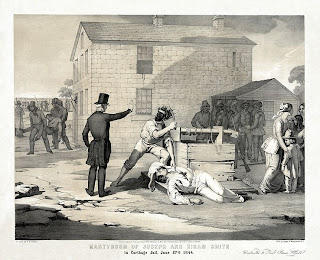
The murder of Joseph Smith(1844)

In the aftermath of its passing, Cherokee Indians were removed from their lands, with the Department of the Interior subsequently outlawing a list of “offensive” Native American rituals. 1844 saw a mass migration of Mormons to Utah; as a result of the violent lynching and murder of Mormon founder Joseph Smith in an Illinois prison. The Ku Klux Klan proceeded to taint American history by putting into place their malicious brand of intolerance, amassing over 4 million members in a crusade of anti-Semitism and anti-Catholicism. To make matters worse, the trying period of the Second World War was marred by a new dimension of religious hatred that Roman-Catholic priest Father Charles Coughlin put forward in American culture, with decidedly anti-Semitic radio addresses. Defending Nazism and Fascism, Coughlin blamed the Depression on an "international conspiracy of Jewish bankers” in a viral CBS radio broadcast. 

A Ku Klux Klan recruitment poster circa 1920

Reverend Charles Coughlin

Today, nearly a quarter of the American population still erroneously thinks Obama is Muslim, probably because of his numerous endeavors to improve America’s tainted image in the Islamic world. His outreach to the American-Muslim though has been much quieter, and so, when Muslims like Imam Rauf and his wife set out to build formal mosques, they are rendered exposed, and vulnerable.


Intolerance, though metamorphosing over periods of time, seems to continue to remain firmly woven in the fabric of American society. Perceptions of Islam have worsened significantly in the past two years. Until a distinction is made between religion and fanaticism, and an understanding reached, that American-Muslims represent a diaspora of every race and sect of Islam, Park51- even if it comes through by way of some miracle- will remain a soulless, empty gesture at most.

Screen Savour: The Art of Cinema by Deepa Rajan

Ever since I was old enough to go to the movies, I have always faithfully performed a necessary ritual. Reaching a bit before the film, I walk up and down the theatre halls, soaking up all the posters of movies- yet to be released, currently playing and of course, the classics.
For a cynic, movie posters are merely yet another kind of advertisement- a commercialized art form, with the essential purpose being to “sell” the movie. This is all completely accurate, with posters prominently displayed on billboards, in the lobby of your local movie theatre, in magazines, on the Internet, and even on the sides of buses- all to make sure that the largest possible number of people are rendered extremely curious, and thus end up watching the film itself.  Sexy images of the movie's most attractive actors and inclusion in bold of the “big” movie star names, designs, colours, and fonts reflecting the mood and tone of the film, and intriguing one liners- this is the essence of movie marketing, the tactics employed to persuade your average movie-goer.

Often forgotten is the fact that movie posters in themselves are pieces of art. They are the products of loving labour, and a great deal of thought and creative genius. If you look at some iconic movie posters, the effort made by the artist to lure the viewer in, to make them question and make them wonder is almost palpable. If movies are like a waking dream-world, movie posters are your invitation to that dream-world. And don’t they always say you should chase your dreams?

La Dolce Vita (1960), Federico Fellini

The film follows a gossip columnist as he makes his way through a seedy underworld of sex, booze and superficiality. In this poster by Georgio Olivetti, Anita Ekberg’s iconic blonde, curvaceous figure represents vanity and vitality and her pose of abandon strikes a chord with the lives of the characters in the film- careening out of control. A smoking Marcello Mastroianni is highlighted in dark hues of blue bringing out the disillusionment of his character, his expression solemn and pondering, fitting for a man who can no longer be surprised by the people around him.


Gone With the Wind (1939), Victor Fleming

The artwork in this poster is a veritable anthology of all the events in the film- the pre-civil war grandeur of Scarlett O’Hara’s plantation home Tara, the Yankee-Confederate struggle and Scarlett’s daring escape during the siege of Atlanta. Central to the poster however is Clark Gable’s smoldering intensity paralleled by Vivian Leigh’s swooning abandon. It provides a showcase of the unfortunate crackling chemistry between Scarlett and Rhett Butler, emphasized by the fiery background painted in rough brush strokes.


Mother India (1957), Mehboob Khan

In this remarkable masterpiece, several key elements of Indian society are succinctly depicted.  Nargis, as Radha, is shown as the epitome of the Indian woman that holds largely true even today- illiterate yet worldly, determined and strong. The plough on her back signifies the immense responsibilities she shoulders as both parent and sole bread-winner. It is also symbolic of the travails of the impoverished farmer- her expression denoting extreme physical effort and pain, despite which battles on.


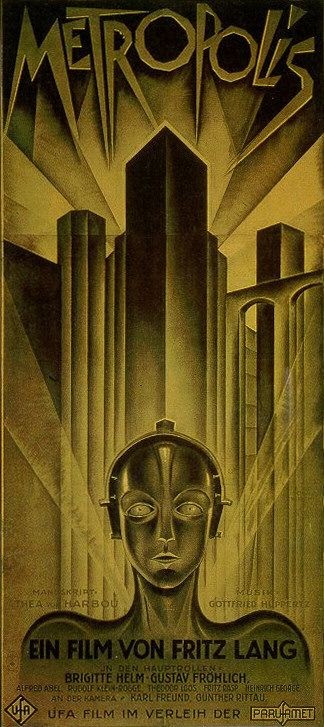
Metropolis (1921), Fritz Lang

Metropolis, the first full-length science fiction (silent) film, is set in a futuristic city where a ruling class live in opulence while a literal underclass toil in a vast subterranean workshop. Heinz Schulz-Neudamm’s extremely influential brainchild, this poster is famed for its cityscape dominated by monumental skyscrapers and futuristic structures. The architectural influences are a studied mixture of German Expressionism, Modernism and Art Deco- all significantly ahead for that time. The machine-human is a forerunner of the Streamline Moderne style, which when applied to science fiction, came to be called Raygun Gothic. 


Vertigo (1958), Alfred Hitchcock


Nothing could have screamed “psychological thriller” louder than acclaimed graphic arts designer Saul Bass’s artwork. The poster is of a man and a woman spiralling into the eye of a vortex. The spiral is white and the man is solid black. The woman however is outlined, invoking images involving chalk outlines of bodies made by the police at a homicide site. The font in itself is a nervous one; the asymmetry giving the impression of instability. Switching from bold, heavy strokes to lighter ones, the font is conflicted, just like the characters in the film. In essence, a study in mystery.


Grindhouse (2007), Quentin Tarantino and Robert Rodriguez

Grindhouse is a combination of two films, inspired completely by the B grade film genres like horror, gore and spaghetti westerns of the 1970s. Just like the movie, the poster too is all-out. Planet Terror depicts a strong, fearless femme-fatale with a machine gun as a prosthetic leg. Death Proof features a black 1971 Chevy Nova, marked with an eerie skull- a portent of doom. The style of the artwork borrows distinctly from early comic book art, with emphasis on black, white and red, and the use of attention grabbing fonts, banners and exclamatory punctuation.


The Bride of Frankenstein (1935), James Whale

High-level artistry is evident in this poster- the faces are right out of a German Expressionist handbook, with structural close-ups, and irregular use shadows and colour. Probably the most recognizable motif of the film is the titular characters' noteworthy hair design (lightning bolt highlights), which in this case morphs into a wild flame, wrapping itself around her intended ‘groom’. This influential masterpiece of Gothic horror was a black and white film, so the artwork was crucial in establishing to the audience that Boris Karloff’s hapless ‘Monster’ was in fact green, setting the precedent for all later depictions of Frankenstein.


Monday, November 22, 2010

A Day In The Life by Deepa Rajan


Gulmarg, Jammu & Kashmir, June 2010

With the advent of summer, Sami and her siblings, part of a group of nomadic Bakarwal tribesmen have travelled well over two months from Jammu to reach the cooler climes of Gulmarg.  Mainly goatherds and shepherds, Bakarwals lead lonely, tough lives in the lush high-altitude meadows of the Himalayas and the Pir-Panjal. This group is stopping at en-route market towns like Gulmarg and Pahalgam to barter livestock for supplies. Bakarwals have a strong sense of community- the boy on the extreme right is the girl's brother, but the one in the middle is an orphan, and hence the tribes-people's collective responsibility.

If you haven't seen this... - Must Watch Films by Deepa Rajan

DO BIGHA ZAMIN (1953)


Director: Bimal Roy
Producer: Bimal Roy; Screenplay: Hrishikesh Mukerjee; Photography: Kamal Bose; Editor: Hrishikesh Mukerjee; Music: Salil Chaudhury.
Cast: Balraj Sahni (Sambhu); Nirupa Roy (Paro); Rattan Kumar.
Awards: Prix Internationale at the 1954 Cannes film festival, Prize for Social Progress at the Karlovy Vary film festival.

In a cinema that is largely associated with merry-making, impassioned love stories and adventure, Bimal Roy’s Do Bigha Zamin is a path-breaking dedication to realism. This 1953 film is a decidedly socialist narrative of an agrarian society slowly been taken over by industrialization and commercialization and the vices that accompany it.

On the surface, the film is a simple portrayal of the woes of the Indian farmer. Peasant farmer Sambhu’s meager ‘do bigha’, comes in the way of the landlord's scheme to sell a large parcel of the farm land to speculators.  The landlord fabricates evidence of an unpaid debt, forcing the farmer to abandon his family and leave for the city to repay the mountain of debt. Roy's use of the familiar musical and melodramatic style enabled audiences to comprehend his film; but his endeavor was markedly different in that it was strongly influenced by the Italian neo-realist Cinema of Rossellini and De Sica. Roy uncompromisingly injected naturalistic elements that prepared the ground for the more unflinching, innovative political cinema of the 1970s.  Every character in the film is a stark representation of a social class - Balraj Sahni as the poor farmer who considers his land to be his mother, Nirupa Roy as the illiterate, strong yet helpless wife and mother, Rattan Kumar as the child witness to the trials his father goes through in the city, the avaricious landlord, and the dying father whose only wish is to see his son save his land. Drawing from De Sica’s masterpiece Bicycle Thieves (1949), the city is depicted as a labyrinthine maze that literally consumes Sambhu’s idealistic aspirations. The chiaroscuro lighting of rickshaw-pullers quarters in Calcutta sends forth a silent yet powerful message of dilapidation and destruction of those who cannot keep pace with the consuming life in an urban jungle.

The narrative of impoverished farmers and avaricious landlords and moneylenders has been told time and time again in Hindi cinema. What makes Do Bigha Zamin such a powerful film is the pessimistic ending where Sambhu and his family look on despairingly at the image of a factory being built on the land stolen from them.  The denial of any kind of satisfying resolution to Sambhu’s poverty is a moving confirmation that social oppression is something monolithic, inevitable and hegemonic. Five decades later, Indian agriculture is still struggling against indebtedness, land-grabbing and crop failure.

 As the citizens of a country where agriculture continues to be an unreliable mainstay for millions, and where the farmer’s burden is one which he has been carrying for well over a century, Do Bigha Zamin is simply, a must-watch.


DR STRANGELOVE OR HOW I LEARNED TO STOP WORRYING AND LOVE THE BOMB (1964)


Director:
Stanley Kubrick
Producer: Stanley Kubrick, Peter George and Terry Southern; Story: Peter George (Novel)
Cast: Peter Sellers, George C. Scott. Sterling Hayden, Keenan Wynn, Slim Pickens
Awards: 4 BAFTA awards, best written American comedy award from the Writers Guild of America.
Stanley Kubrick’s Dr. Strangelove is based on a single fail-safe principle of good comedy: people who are trying to be humorous are never even as remotely funny as people trying to be serious and failing. In arguably one of the best political satires till date, Kubrick maximizes on rudimentary props, a small cast and a modest special effects to deliver a hilarious adaptation of Peter George's Cold War thriller novel Red Alert.  The story involves an unbalanced United States Air Force general Jack D. Ripper (Sterling Hayden)who orders a first strike nuclear attack on the Soviet Union. Chaos ensues and the narrative continues to the ‘war room’ at The Pentagon where the President of the United States , his advisors, the Joint Chiefs of Staff and a Royal Air Force (RAF) officer try to recall the crew of the B-52 bomber aircraft to prevent a nuclear apocalypse. When the Soviet Premier reveals that that their country has deployed a doomsday device, the President proceeds to call upon the sinister Dr. Strangelove, a former Nazi and weapons expert.
Dr Strangelove is marked by excellent comic performances, which is just as well because there is so little in the film apart from faces, gestures and words. George C. Scott’s facial gymnastics make him surprisingly convincing as the over-the-top and patriotic General Buck Turgidson. Peter Sellers effortlessly portrays three distinct characters in the film, that of RAF Group Captain Lionel Mandrake, ineffective President Merkin Muffley as well as the titular role. And it is Dr. Strangelove that truly stays behind with the audience, with his weird accent and gloved hand that seems to be a deadly weapon on its own, often springing into Nazi salutes and trying to strangle Strangelove to death.
It is not, however, just the comic elements of the film that make it a must-watch. The film takes potshots at numerous Cold War attitudes- especially that of mutual assured destructionDr. Strangelove humorously but effectively pulled the rug out from under the Cold War by arguing that if a “nuclear deterrent'' destroys all life on Earth, it is hard to say exactly what was being deterred.

Sunday, November 21, 2010

Paharganj by Deepa Rajan

The busy Main Bazaar


Paharganj is one of two places in the capital city instantly recognized by most Delhi-ites as Delhi's seedy underbelly, second in  ‘shadiness’ only to Palika Bazar. Possessing an exotic, colourful past, Paharganj has been shaped by tumultuous changes in the historical evolution of New Delhi.  Originally a suburb of the erstwhile Mughal walled city, the face lift given to this area by a certain Sir Edwin Landseer Lutyen, is the reason why one can stand before and marvel at the positively archaic Imperial Theatre today.

The partition of India proved to be another period of metamorphosis. A tremendous influx of refugees from Pakistan were allotted shops in Paharganj, who faced with the dire need of making a fresh start, took up the business of eateries. Some of the famous names established since 1947-48 are doing excellent business even into the third generation of ownership. I was told to visit eateries that thrive till today, such as 'Pehalwan da Hotel' and 'Sitaram Diwan Chand'. I stopped in at the latter, also popularly known as Sitaram Bhaturewala. And really, chole bhature never tasted better.

Paharganj was most lastingly impacted by the 'Hippie Movement.' It is home to cheap hotels, originally meant to suit hippie backpackers, which are now ideal for travellers on a shoe-string budget. 'Hotel Cottage Yes Please' and 'Hotel Relaxxx' promise to fulfil all your ‘Shantaram-esque’ needs at a bargain price while giving you something to laugh about for free.

In the main market it is plain to see that till date, Paharganj preserves its quaint air of the '70s, and for the young and the offbeat, it is a mecca of ceaseless delights. Numerous new-age book shops are filled with all kinds of attractive titles including yoga, tantra and karmic philosophy- strange trance music leading you through their doors. I saw bright patchwork pyjamas, hookahs, glass lamps, painted doorknobs, antique gramophones, silver jewellery, ancient tomes and gold coins- the list is endless.

Paharganj is a utopian food paradise, dotted with eclectic eateries. Visiting ‘Sam's Cafe’, with its elegant rooftop setting, ‘Korean Cafe’ with its rather questionable menu and the popular 'German Bakery’ would be simply scratching the surface. After a while, you suddenly realize why foreign tourists are so at home in Paharganj- to my great amusement, the waiters communicated effortlessly with tourists in spurts of stylishly accented English, and even in bits and pieces of French and German learned by them over years of serving tourists.

If I try to encapsulate the lure and charm of the narrow, dirty streets of Paharganj in a few words, all I can say is that it is a world within a world, and a time within a time. It is an intense kaleidoscope of the eccentricities and oddities of India and the world alike. And, like some of the wines served in its modest restaurants, it is best enjoyed exactly as it is.