Showing posts with label Arts Culture and Entertainment. Show all posts

Tuesday, November 23, 2010

The Social Network by Akanksha Narain


Gone are the good old days of letters and pen pals, thanks to the numerous social networking sites cropping up. Status updates, photo comments, wall posts and tags- that’s how the Gen Y does it. The internet has created a new rage of networking and connecting with the world around us.

Every passing day seems to back Marshall McLuhan’s claim that the media would make the world a ‘Global Village’, sites like Facebook being primary examples. Children as young as 5 years old are well versed with the activities that social networking entail- from liking posts to uploading photographs.

Social networking inevitably has returned to the spotlight as an issue of contention with the recent release of “The Social Network” – a film that explores the life and success of shrewd and prodigious Facebook creator Mark Zuckerberg, played by Jesse Eisenberg. The question inevitably raised in a discussion of this sort is that with the advent of sites like Facebook are we venturing into deep waters? On such sites we unknowingly drop our guard, putting up rather personal information and photographs for the world to see. We put up photographs of ourselves holidaying in Goa while burglars happily see this and rob our houses. How difficult is it to plan a robbery when we ourselves inform the world when it is that we will be returning home?

With the explosion of the phenomenon of the internet, parents began to express extreme worries about their children accessing questionable chat sites and giving out information to strangers who might take advantage of it. We all have heard of numerous cases of kidnappings and children running away with strangers they met on such sites. Social networking sites have definitely aggravated this situation. The recent rape case in Delhi, where the victim met the culprit on Facebook is a fine example.

On such sites we not only expose too much information that could be misused by unsocial elements but also information that could cost us our jobs and marriages. Thanks to Facebook bosses now know that whether you were really unwell or were actually partying with your friends, all thanks to your status updates! Moreover, thanks to social networking sites all your claims of being a teetotaller are quashed. Before marrying anyone parents and the to-be groom/bride go through your profile and pictures to know what sort of a person you really are.

So the next time you go on Facebook set up your security setting and make sure that you do not put information that could be misused by people.

Despite Uncertainty, Blogs Positively Gain Momentum by Malvika Tripathi


In about 20 years, Internet has grown from its infancy stage of surfing for information to a highly complex interdependent grid comprising of social media interacting with advertising and marketing models, along with superfluous information emanating from independent sites, bloggers or news websites. In essence, Internet has emerged multifaceted and the sheer multiplicity in content is what characterizes it today. The demographics comprise of Facebook and Twitter (social websites) and blogs which aggregates into one central feature-spontaneity. Earlier considered a means of data, it is now a platform for testing new technologies, business models and as experimental grounds for advertisers.

Web Logs, or blogs, are the most successful and contemporary form of expression on the web in recent times. Coming from a grey area in journalism, every blog has a theme and unique point. Bloggers do not always write with a time frame in mind they’re entirely on the discretion of the blogger whether it is serious like Huffington Post or an excuse to vent like a personal diary. A blog is intangible property with respect to its writer. They are fully responsible if anything controversial is put up. Plus its effect is instantaneous and high on interactivity with sometimes torrential comments within minutes. “Freedom of press is guaranteed only to those who own one”. Although, this would not hold true for conventional media giants but blogging sites have redefined press in a broader sense. It acts as an autonomous network for collective conversation in the modern day public sphere. But now multinationals, newspapers, magazines and even celebrities keep blogs either as a public relations necessity or gaining an upper hand in the blogosphere.

Numbers may argue that the blogging scene has diminished in its present status, the advent of networking sites have ousted blogging more into ‘irrelevance’ than ever before.  So given that the world hasn’t figured what exactly blogs are, let us assume that they are provisional (since mostly they require great deal of maintenance and instant analysis) and offbeat in style of expression. Blogs have still maintained an upward course, in gathering netizens at about 175,000 – 225,000 every day. Blogging is quite young as about 120 million blogs exist. Interestingly, a whopping 50 percent of internet traffic visits these 120 million blogs. The potential of this dynamic medium is often grossly miscalculated if not ignored. It can possibly hold be the most effective advertising online. As blogs cater to niche viewers, understanding consumption pattern and target groups is viable intercepting the portion of readers. 47 percent of online consumers now read blogs for advice. The blog networks that have survived the economic downturn in advertising and the explosion of competing content on the web credit coverage of narrow topics, along with business models that reach beyond advertising. Meanwhile (according to NY times), advertising revenue for magazines dropped 21 percent, and the number of ad pages sold dropped 28 percent. Blogs have also started to get recognised by Media Firms such as Washington Post (for the last 6 years) and recently Associated Press as a credible news source. Mainstream media has rebroadcasted and reported on factual information from blogs especially in time of conflict like during the Iran election protests or Myanmar military repression.

Another unprecedented phenomenon is complete liberty to bloggers over the advertisements that get placed, like in Google ads. Especially, where ownership is concerned, they are responsible for what goes up on their site and how well it will resonate with the readers. In terms of traditional media, it is path breaking because advertisers cannot directly influence content this way round. Such advertising models are light years ahead of print media. Newspapers have realised the prospective of blogs and blog advertising and are making the most of it.

Blogs are foreseen as a substantial part of the web. Innovators searching for inspiration for the next big thing will find it understanding how software programming and optimization of content can do.

The Man Who Left Behind A Legacy by Deepa Rajan

Stieg Larsson

At the risk of over simplification, Stieg Larsson is identifiably the Van Gogh of crime fiction. 

Just like the tempestuous painter, Larsson died an untimely death- much before he could bear witness to the phenomenal success of his trilogy. More importantly, in one of his letters, Van Gogh is known to have admitted that as he did not have any children, he viewed his paintings as his progeny. Larsson too, has no heirs to call his own, apart from the girl with the dragon tattoo, the one that kicked the hornet’s nest, and the one that played with fire.
Since they were posthumously published in 2005, Larsson’s Millennium Trilogy has catapulted Nordic Noir into the global literary space. Already hugely popular in Europe, so far, over 27 million copies of the Millennium novels have been printed, and the books have been made into three wildly successful Swedish films.

What really seems to make these books work is their setting. A completely Scandinavian crime thrillers crafted around journalist Mikael Blomkvist and his firebrand, tattooed, pierced, prodigious, bisexual computer hacker partner Lisbeth Salander- a duo that takes on corrupt businessmen, sex traffickers, violent bikers, junkies and crooked politicians. The main attraction of the books is the Sweden portrayed through the eyes of Larsson. There is meticulous attention to detail in Larsson’s work and as you read, every page paints a striking picture. The author, who clearly loved this place, and made it a point in his books to use real addresses and locations.  At the same time, the Sweden he gives us is real- freeing readers from the constraints of imagining it as a streamlined Ikea-esque paradise.  It has its share of demons too, very much like our own countries.


And then there are the characters. Blomkvist proves to be a complete antithesis to standard crime fiction detectives doomed to a perpetual state of brooding unhappiness. Identified as Larsson’s alter ego of sorts, Blomkvist is remarkably upbeat and socially well adjusted- exactly how Larsson is remembered by his friends.

Salander, is an infinitely more complicated conundrum- described as elfin, barely 90 pounds and as having dyed black hair “short as a fuse”, she possesses a sordid past to match her Goth appearance. Abused and wrongfully institutionalized as a child, Salander exhibits a world of scepticism about the potential of human goodness. Not really your average hero. What’s important though is that she represents the mistrust and cynicism that exist in the bowels of every human mind- doubting figures of authority, the people we love and even ourselves. Pippi Longstocking, the strong-willed character of Astrid Lindgren’s children’s books is cited as Larsson’s inspiration for Salander. Salander is a testament to all those who survive torturous childhood experiences and somehow grow into adults with notable skills and an intact distinction between right and wrong. But there are also perhaps elements of Larsson himself in her- they shared a diet consisting almost entirely of coffee, cigarettes and fast food- one of the reasons cited for Larsson’s heart attack- a fanatical disposition towards research and a resolute sense of justice and fairness.


Lisbeth itself is the namesake of a rape victim that Larsson in his childhood is said to have been unable to help. It is perhaps for this reason that through the Millennium trilogy there is a feminist undercurrent, and Larsson brings to prominent focus his abhorrence of violence against women. Despite numerous suggestions Larsson refused to change the rather grim Swedish title of the first volume, “Man Som Hatar Kvinnor,” or “Men Who Hate Women.”

Larsson died without leaving a will. This has resulted in an intense struggle between his partner Eva Gabrielsson and Larsson’s father and younger brother.  Although legally Gabrielsson has no claim, she possesses a crucial piece of the Larsson legacy: a laptop computer containing roughly three-quarters of a fourth novel. According to Gabrielsson, in 2005 the Larsson’s offered to give her Stieg’s half of their apartment in return for the laptop. She refused, calling the offer extortion, and they eventually relented, very likely under the weight of public opinion, and let her have the whole apartment for nothing. Last November, the Larsson’s told a journalist that they were willing to settle the dispute for 20 million kronor (roughly $2.6 million). Gabrielsson didn’t respond.


In 1995 Larsson co-founded Expo, an anti-racist Swedish publication on which Millennium is loosely based. Despite its humble beginning the magazine nevertheless succeeded in upsetting the people Larsson was writing, about exposing him to multiple death-threats as an “enemy of the white race.” Such right-wing extremism was a legacy from World War II, when some Swedes secretly supported the Nazis, particularly rampant in the 90s.  This convoluted history has invariably fuelled speculation regarding Larsson, embroiling him in a variety of conspiracy theories that persist on calling his death an assassination. Life doesn’t necessarily imitate art but in this case, Larsson himself has now become one the opinionated, upright Swedish characters in his own books- entwined in a tale of envy, vested interests and mysterious manuscripts.

Coincidence? I think not! by Gurmat Randhawa

According to Wikipedia, a conspiracy theory attempts to attribute the ultimate cause of an event (usually major political, social, historical, or cultural events), chain of events, or the concealment of causes from public knowledge, to a secret and often deceptive plan by a group of people or organizations. 
Basically, it means that conspiracy theorists try to find hidden meanings and/or hidden motives to explain certain major events. Popular conspiracy theories include John F. Kennedy’s assassination, Area 51, Man on the Moon and many more. Here is a list of conspiracy theories that may change the way you look at the world.


Paul is Dead.

So apparently Paul McCartney died in 1966. And the Beatles covered it up by hiring a look-alike who looked, sang AND behaved like him. But, they eventually felt guilty about deceiving the fans and started hiding clues in their music and album covers. So the Sgt. Pepper’s Lonely Hearts Club Band album was allegedly full of references to Paul’s alleged death. For example, the song “A Day in the Life” when played backwards sounds like “Paul is dead, miss him, miss him”. Also, the cover of the Abbey Road album apparently shows John, George and Ringo crossing the street as a funeral procession. John wearing white symbolising a clergyman; Ringo wearing black symbolising a mourner; and George wearing jeans symbolising a gravedigger. Paul was not wearing any shoes, and walked out of step with the others, symbolising him being dead. However, John Lennon has denied the existence of any hidden messages in either album covers or in their music.

Paul? Fake Paul?

NASA faked the moon landings.
The story goes that in a bid to defeat the Russians in the space race, NASA faked the landings on the moon. It was supposedly filmed on a film set located either in the Hollywood hills or in Area 51. The origin of this theory is the part of the film which shows Aldrin planting a waving American flag on the moon. This should not be possible as the moon has no atmosphere, just vacuum. Also any and all visual material related to the landings is only provided through NASA, so there can be no independent verification whatsoever. The best part? That Stanley Kubrick apparently helped them fake it because he had experience from making 2001: A Space Odyssey. So all the moon rocks the astronauts brought back? You decide.

You can see the strings people!!-Phoebe from Friends


Lizard People Rule the World
Ever heard of a guy named David Icke? This former BBC sports presenter believes that our world is actually controlled by shape-shifting extra terrestrials or ‘lizard people’. He claims that these people are part of a network of interbreeding bloodlines with extra terrestrial origins. Important bloodlines include the British House of Windsor, the Rothschilds, the Rockefellers and most of European royalty. According to him this ‘Global Elite’ controls the IMF, United Nations, the media, military, science, religion and even the Internet. So, the British royal family, other royal families and most of the US government are apparently lizard people. So the next time you see George Bush, look closely. He might be one of THEM.

All hail our Lizard King!

 Secret societies control the world.
This one is in the same vein as the last one. Most of us have read Dan Brown right? Angels & Demons and the Da Vinci Code. In those books he talks about the Illuminati and the Freemasons. So this theory says that they control the world. It’s similar to Icke’s theory in that according to this theory members of these groups hold offices of power across the globe. The Illuminati are supposedly responsible for the pyramid-and-eye symbol on the dollar bill, as we all know from reading Angels & Demons. The Freemasons call themselves the oldest worldwide fraternity and list George Washington as one of its well known members. Did you know that there is a Masonic lodge on Janpath?


There is no such thing as Global Warming.
This theory says that the global climate scientist community has gotten together and created a vast body of data and literature to convince the world of a global change in climate because of unhealthy environmental practices because they want funds or indirectly political power. And the fact that the scientists of the world are divided on the whole global warming phenomenon doesn’t help. Well, atleast Al Gore got a Nobel out of it. An inconvenient truth, anyone?

And an Oscar.

The JFK Assassination
John F. Kennedy, the 35th President of the United States, was assassinated on the 22nd of November, 1963 in Dallas when riding in an open car. He was shot twice, in the head and in the neck. A commission under Chief Justice Earl Warren was constituted. The Warren Commission declared that the man arrested on suspicion, a Lee Harvey Oswald, was the culprit, and that he had acted alone.


However, the trajectory’s of the bullets that struck Kennedy and Dallas Governor John Connally (who was sitting in the front of him) when analysed indicated that Oswald could not have made all those shots from where he was stationed, and there must have been another shooter.  It is believed that the other shooter was stationed on the grassy knoll of Dealey Plaza. The Warren Commission and other US government agencies deny the existence of another assassin. So conspiracy theorists believe that JFK was killed as a result of a conspiracy against him. Alleged conspirators include the CIA, then Vice President Lyndon B. Johnson, Fidel Castro, the FBI, the Mafia and many, many more.

Screen Savour: The Art of Cinema by Deepa Rajan

Ever since I was old enough to go to the movies, I have always faithfully performed a necessary ritual. Reaching a bit before the film, I walk up and down the theatre halls, soaking up all the posters of movies- yet to be released, currently playing and of course, the classics.
For a cynic, movie posters are merely yet another kind of advertisement- a commercialized art form, with the essential purpose being to “sell” the movie. This is all completely accurate, with posters prominently displayed on billboards, in the lobby of your local movie theatre, in magazines, on the Internet, and even on the sides of buses- all to make sure that the largest possible number of people are rendered extremely curious, and thus end up watching the film itself.  Sexy images of the movie's most attractive actors and inclusion in bold of the “big” movie star names, designs, colours, and fonts reflecting the mood and tone of the film, and intriguing one liners- this is the essence of movie marketing, the tactics employed to persuade your average movie-goer.

Often forgotten is the fact that movie posters in themselves are pieces of art. They are the products of loving labour, and a great deal of thought and creative genius. If you look at some iconic movie posters, the effort made by the artist to lure the viewer in, to make them question and make them wonder is almost palpable. If movies are like a waking dream-world, movie posters are your invitation to that dream-world. And don’t they always say you should chase your dreams?

La Dolce Vita (1960), Federico Fellini

The film follows a gossip columnist as he makes his way through a seedy underworld of sex, booze and superficiality. In this poster by Georgio Olivetti, Anita Ekberg’s iconic blonde, curvaceous figure represents vanity and vitality and her pose of abandon strikes a chord with the lives of the characters in the film- careening out of control. A smoking Marcello Mastroianni is highlighted in dark hues of blue bringing out the disillusionment of his character, his expression solemn and pondering, fitting for a man who can no longer be surprised by the people around him.


Gone With the Wind (1939), Victor Fleming

The artwork in this poster is a veritable anthology of all the events in the film- the pre-civil war grandeur of Scarlett O’Hara’s plantation home Tara, the Yankee-Confederate struggle and Scarlett’s daring escape during the siege of Atlanta. Central to the poster however is Clark Gable’s smoldering intensity paralleled by Vivian Leigh’s swooning abandon. It provides a showcase of the unfortunate crackling chemistry between Scarlett and Rhett Butler, emphasized by the fiery background painted in rough brush strokes.


Mother India (1957), Mehboob Khan

In this remarkable masterpiece, several key elements of Indian society are succinctly depicted.  Nargis, as Radha, is shown as the epitome of the Indian woman that holds largely true even today- illiterate yet worldly, determined and strong. The plough on her back signifies the immense responsibilities she shoulders as both parent and sole bread-winner. It is also symbolic of the travails of the impoverished farmer- her expression denoting extreme physical effort and pain, despite which battles on.


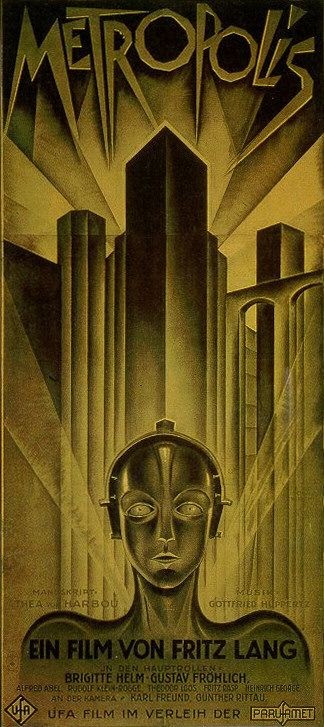
Metropolis (1921), Fritz Lang

Metropolis, the first full-length science fiction (silent) film, is set in a futuristic city where a ruling class live in opulence while a literal underclass toil in a vast subterranean workshop. Heinz Schulz-Neudamm’s extremely influential brainchild, this poster is famed for its cityscape dominated by monumental skyscrapers and futuristic structures. The architectural influences are a studied mixture of German Expressionism, Modernism and Art Deco- all significantly ahead for that time. The machine-human is a forerunner of the Streamline Moderne style, which when applied to science fiction, came to be called Raygun Gothic. 


Vertigo (1958), Alfred Hitchcock


Nothing could have screamed “psychological thriller” louder than acclaimed graphic arts designer Saul Bass’s artwork. The poster is of a man and a woman spiralling into the eye of a vortex. The spiral is white and the man is solid black. The woman however is outlined, invoking images involving chalk outlines of bodies made by the police at a homicide site. The font in itself is a nervous one; the asymmetry giving the impression of instability. Switching from bold, heavy strokes to lighter ones, the font is conflicted, just like the characters in the film. In essence, a study in mystery.


Grindhouse (2007), Quentin Tarantino and Robert Rodriguez

Grindhouse is a combination of two films, inspired completely by the B grade film genres like horror, gore and spaghetti westerns of the 1970s. Just like the movie, the poster too is all-out. Planet Terror depicts a strong, fearless femme-fatale with a machine gun as a prosthetic leg. Death Proof features a black 1971 Chevy Nova, marked with an eerie skull- a portent of doom. The style of the artwork borrows distinctly from early comic book art, with emphasis on black, white and red, and the use of attention grabbing fonts, banners and exclamatory punctuation.


The Bride of Frankenstein (1935), James Whale

High-level artistry is evident in this poster- the faces are right out of a German Expressionist handbook, with structural close-ups, and irregular use shadows and colour. Probably the most recognizable motif of the film is the titular characters' noteworthy hair design (lightning bolt highlights), which in this case morphs into a wild flame, wrapping itself around her intended ‘groom’. This influential masterpiece of Gothic horror was a black and white film, so the artwork was crucial in establishing to the audience that Boris Karloff’s hapless ‘Monster’ was in fact green, setting the precedent for all later depictions of Frankenstein.


Monday, November 22, 2010

Current Attitudes In The Indian Independent Music Scene by Ramya Patnaik


Photo courtesy Rahul Lal
Thus spake a beautiful man with a beautiful beard: “Indian metal has hit puberty, now it only needs to get laid”... To those who call us a product of “western ideals”, to those who claim we don’t exist, we raise a familiar finger in response to their ill-informed, half-baked assumptions. But the independent music scene in India has come a long way from a time that recognized it as just a rebellious wing of mainstream culture. Or has it? Long years ago we made an aural tryst with Guns N' Roses, Nirvana and Metallica. Today, Iron Maiden have openly professed their love for their Indian fans; Joe Satriani, Opeth, Freak Kitchen, Guthrie Govan and Infected Mushroom have come and gone and come winter, fans will have a lot to cheer about courtesy Meshuggah, Enslaved, George Howe and The Prodigy. More importantly, Indian rock band The Circus are currently Down Under, Hardcore/Metal band Scribe are back from their gig at THE INFERNO METAL FESTIVAL, Norway and Black/Death/Power Metal act Demonic Resurrection from BRUTAL ASSAULT, the Czech Republic. While these examples may sketch a rough sense of familiarity for those not actively involved with The Scene, there is a great need to gauge the actual temperature of what’s really happening in the community.

An initiation into the scene via a gig may yield two responses: either blind love, or utter disdain. The real or perceived problem however is, that most of us are comfortable with retaining the first impression we have of Indian musicians in the independent scene. Those who make an effort to understand the processes that go behind ideas and events and the people-bands, officials, audience, critics etc, will point out the screeching naivety of such thinking. The nuances of its history, the nature of its present and the scope of music in the future all merit documentation akin to any other socio-cultural process that engages great thinkers and analysts with its fascinating working. The fact that it is the Indian context that we are talking about would intimidate one because of the need to be extremely accurate in basic definitions. Also, there are too many things involving too many people that to ignore an aspect would be by no means an insignificant risk.

Motherjane live at BITS.Photo courtesy Rahul Lal

Taking a timeframe of the past 10 years is a good idea to start with because most established bands of today started out back then and also because development in the last decade has been more visibly momentous than ever. In its nascent stage, basic rock and metal music was greeted with much enthusiasm albeit as an alien trend lacking the ability to touch the average college-going enthusiast in any real way. Photographer Rahul Lal who has played bass with the band Prestorika talks about the mindset prevalent amongst his peers when the band first started out. “Initially we weren’t aware of any Indian bands other than Parikrama. We were totally influenced by western bands. We started playing for the fun of it. As things moved ahead and we began to be paid for gigs, it became an obligation to play well. Practice sessions became more serious. Not everyone had the same attitude towards playing, though...stricter practice meant less ‘daaru’ and fooling around with chicks. So some got more serious, others drifted away.” Adds Workshop and Albatross bassist Riju Dasgupta, “Back then, it was the cool thing to do and the only legal way to grow your hair long. I thought WWE wrestlers looked really cool with long hair and this gave me an excuse along with my favourite bands back then, Iron Maiden, Judas Priest, AC/DC, Mercyful Fate etc.

The essence of the scene as a collective of people draws from the fans. It’s safe to say that most people in the audience are acquainted with the bands and their music by the time they get to college. I asked Siddharth Chakravarti, an avid fan of metal, about the general level of knowledge among people today and if they react differently to gigs from say, 5-6 years ago. “Well...you still see plenty of poseurs in the Delhi scene unfortunately. (But) the scene has improved vastly from bands’ set lists to resources to general acceptance. People know their metalcore; I'll give you that...at least in Delhi.” When asked to comment on the ability of audience members to discern between bands’ sounds, Riju Dasgupta believes that “...onstage, the actual music is 25% of the act; the crowd comes to have a good time and in my opinion anything which makes them have a good time is good. Bands today have to nail that 25% plus offer something else. So unless your music bit is down and tight, the more intelligent crowd of today gives you no quarter.” Amateur musician and a regular at the circuit Piyush Verma was asked if he thought the people who come for gigs have an ear for and good knowledge of music. He points out the phenomenon of “quick judgement on the part of listeners who lack the patience to sit through the music of a musician before forming an informed opinion.” Concurs Akshaya Patwal, another fan and frequenter of the Delhi Metal circuit that even though the enthusiasm is definitely there, many people lack actual knowledge and prefer to live with assumptions than to learn- it is assumed that “if the vocalist can growl loudly, he is good...It’s basically cool to be a long-haired guy and live with the label of a ‘metalhead’”

The relationship between fans and musicians varies from band to band. While almost every new or well-established band has a Facebook page, is there any real interaction with fans? Sahil Makhija of Demonic Resurrection (DR) and Workshop insists that new or old, DR connects with all their fans. “We meet and talk to them at gigs all the time. If someone comes up to us we always make it a point to talk to them and we don't act like dicks!We are also connected online... I would reply to every Orkut scrap and now I answer almost every message, wall post, email etc from a fan.”

However it cannot be dismissed that a level of high-headedness does exist amongst certain people who hold positions of greater authority in the circuit, and amongst some of those who have been around for many years and are involved with management. This general opinion may never be accepted by the people in question but is like a victimless crime that can never be easily proven beyond personal anecdotes.

‘Poseur behaviour’ is an element that worries many serious musicians and enthusiasts. The popular magazine RSJ is criticised (albeit rarely openly) for being too exclusivist in its approach to incorporate real opinions and trends of the average crowd. However, it is often criticised in the same breath for selling the ‘rocker’ or ‘metal’ lifestyle through mainstream strategy and forgetting to look at music along with its nuances. While nobody disputes the pioneer role it has played in the marketing of Rock music as a viable commodity in India, it is hard to come across a non-RSJ employee in the scene who harbours a completely favourable image of the group.

Bhayanak Maut live at BITS. Photo courtesy Rahul Lal
The beginning of the journey for most kids may bear a strong resemblance to the story of Nishtha Kanal, an avid Mumbai gig-regular. “I was volunteering for my college fest gig which was being headlined by Devoid and Bhayanak Maut as I was interested in the organization part. Then two years ago I went for ‘Independence Rock’ (one of India’s oldest rock festivals) and that happened to be Zero's last gig. They were so amazing that I went home and downloaded their tracks. Before that I had had the feeling that Indian bands would never match up to the standards of big bands from abroad, which is why I had never bothered to listen to them.” Today she believes that bands like Zero are one of the best acts in India and deliver a better gig than some international bands. Lal believes that the audience isn’t “stupid anymore” and has plenty of options to choose from which means that few people can get away with playing just about anything on stage.

With sociological changes, parents are a little more easy-going when bringing up their children today. We see more school-going children at music events than ever before, both in and in front of the audience. And this has been a process spread over years. So is today’s audience getting younger, a trend to stay? According to Nishtha, parents play a much reduced restrictive role these days, allowing their children to attend concerts. “But this hasn't happened overnight. It took a long time, and if the mentality has to further improve, it’ll take longer.”

When asked whether the new generation focuses on refining their skills or get carried away by the coolness of it all, Siddharth opines, “The moment a kid gets passionate about his music...the first thing he wants to do is pick up an instrument and get on stage... especially in a genre like Metal, the power which a Metal gig projects... (pushes) kids to learn the guitar, the drums, even start singing/growling. People who are really into music are usually very devoted to their instruments once they start. On the other hand, you do see people picking up instruments for the cool quotient as well, but they usually learn 3 chords and call it a day.” What about the responsibility of the bands who inspire youngsters, in helping the audience mature?  “The bands do play a huge part; every kid has his/her musical idols- someone who you'd want to be like, at least when you start playing instruments...as you get better with time and practice, you find your own space... but the bands do play a huge part in pushing kids to pick up instruments in the first place.”


Is music as an art form missing out on its chance to endear itself to a crowd that is concerned with being like one’s idol but not the spiritual growth of one’s skills? Shantanu Chakravorty is a musician from Bangalore who is currently tabbing lessons for the guitar genius Rob Marcello on www.torrins.com. He believes that the root of all evil is in the way people practise. “It is surprising that people playing for as long as 25 years end up with bad playing habits and technique.  If you don’t beat yourself mercilessly when you practise...it becomes the sole cause of what we’re talking about. People need to learn to criticise themselves, not others.”
Motherjane live at BITS. Photo courtesy Rahul Lal

Says Siddharth, “polyrhythmic/Mathcore is the 'in' thing these days. Many bands use odd time signatures for the heck of it...it will come and go, just like black metal did with DR. While I don't blame bands for milking whatever success they get, this is where the poseurs/casual fans come in. For a lot of these fans, especially in Delhi, Undying Inc. is just music to swing your arms like an ape to. These 'fans' would react the same way to most forms of metal... see here's the thing, people who are into polyrhythmic metal bands like Meshuggah, Ion Dissonance, Periphery, Xerath etc will appreciate Undying for what it is- a band that has worked hard to get to where it is today, having endured plenty of brickbats in their early days. Delhi kids...don't need intellectual stimulation. They need a catchy chorus, a hook, a melodic bridge section or a heavy breakdown in which they'll punch each other’s faces... because that’s what true metal fans do apparently.”

Lal is of the opinion that “we're yet to mature enough as a music community to create an experience and not just a gig”. However, Riju believes that the difference in today’s kids is that they are “much better musicians than kids of my generation”. Many Indian households encourage young ones to join post-school music classes, especially if parents are musically-inclined too. Their children do extraordinarily well in their chosen vocation, even pursuing advanced education in music. What drive them are the respect for their art and the basic love for their instrument. When the monocles of definition, attire and frills are rejected, it becomes clearer to a musician that pure bliss and music for the sake of music are the ideals worth inculcating.


To gain a more refined perspective on the mindset of youngsters taking music classes, I spoke to Lambu Ata (name obviously changed; those who didn’t get the ‘Gunda’ reference immediately, lead extremely unfulfilled and sad lives), an accomplished musician playing with a well known band and running his own music school in south Delhi. He thinks that impressionable enthusiasts observe what happens in the scene and want to gain female attention with some shred action. But some honest students are very much steeped in the mastery of their skill. He rues, “Dishonest students take tuition classes and school-work seriously but watching a movie or chilling at home is an easy alternative to music classes for them.”
Textures live at IITD.Photo courtesy Maanas Singh

It’s easy to lose focus and join the doomsayers in condemning the future of our scene to permanent obscurity. It took a long time for the veterans to taste success in their endeavour, which is why wherever one looks, they seem to dominate. In the course of a casual conversation with a friend I realized that the bands young people support don’t even belong to their generation. An entire section of some very radical music is being ignored. While the poseurs will never cease to exist, it is extremely important to note that today’s generation of musicians like Guillotine, Devoid, October etc. are taking bigger risks, learning how to play more demanding styles and listening to much better music than their seniors. The underground/ independent scene is dominated by Metal, unlike scenes abroad where it is mostly a niche genre. Siddharth believes that “a turnout for a Metal gig may be more than say, a Blues gig, but the Blues crowd know their stuff, which isn’t always true for the Metal crowd”.
We forget that when the din dies out, the baton-bearers of the independent music scene will be the very musicians who for reasons voluntary as well as circumstantial, make up the REAL underground. While some choose to take stage early, others work on their technique for years before committing themselves to a band. The majority of musicians in the scene are everyday kids jamming in their bedrooms.

Bhayanak Maut at BITS. Photo courtesy Rahul Lal
It’s hard to make your voice count, harder still to make a full-fledged musical career in a system that is managed entirely by a coterie of people who seem to have been appointed by nobody in particular to manage something many of them don’t even understand the depth of- MUSIC. According to Lambu Ata, the scene is a lot more open to new sound these days, which has simultaneously opened the floodgates to more youngsters. But music is still not a viable career option in Delhi because there aren’t many studios nor schools for music that provide a degree course in music, although plenty offer certificate courses. Down south, schools like A R Rahman’s K.M. Music Conservatory, Prasanna’s Swarnabhoomi Academy of Music provide better infrastructure for musicians to follow their passion with diligence. Here, a combination of knowledge, fame and money are essential but elusive too, to make it big. Lambu Ata does however, credit television reality shows like Channel V’s ‘Launch Pad’, MTV’s ‘Rock on with MTV’ and Sony’s ‘Fame Gurukul’ in giving a boost to new talent. RSJ remains the unrivalled monopoly when it comes to organising a gig in most cities. Says Lambu, “Few other companies plan events at a local level. They are also the ones bringing international acts to India; so they behave selfishly and kind of molest a small band- they provide a platform to perform, but don’t pay them. This continues till the band members put their foot down and refuse to play without money. The harassment of talented bands is a malaise that comes with a single monitoring agency for gigs in Delhi.” Sahil Makhija has been widely criticized about publicising his band with an overzealous energy. But he makes a vital point about the need for bands to take on responsibility for themselves. He explains, “There was no one to do anything for me so I did it myself. Everything I do is born from the need to be successful. Sadly people are delusional about music and bands and the business part of it. Just because they don't see Metallica members selling their music or CDs etc doesn't mean they aren't being sold. Every band including Metallica has stood at merchandise stalls after gigs and sold their CDs and t-shirts. People don't realize that, they think there is something wrong with it. But in short I did everything because it was required and because I love doing it.”

Motherjane at BITS. Photo courtesy Rahul Lal
By the time I had finished researching for this article, I was mildly glum. But the last person I spoke to was a junior of mine from school. He currently drums for a band that is among the new crop of Metal acts in the capital called Scythus. The appeal of their music aside, his attitude renewed my hope. “We’ve all heard that the Indian/Delhi music scene isn’t going anywhere...but for me life and soul being music, I frankly don’t care what people say. Everyone has a dream, and my dream, my band’s plan is to be a stage/studio artist...”

If you haven't seen this... - Must Watch Films by Deepa Rajan

DO BIGHA ZAMIN (1953)


Director: Bimal Roy
Producer: Bimal Roy; Screenplay: Hrishikesh Mukerjee; Photography: Kamal Bose; Editor: Hrishikesh Mukerjee; Music: Salil Chaudhury.
Cast: Balraj Sahni (Sambhu); Nirupa Roy (Paro); Rattan Kumar.
Awards: Prix Internationale at the 1954 Cannes film festival, Prize for Social Progress at the Karlovy Vary film festival.

In a cinema that is largely associated with merry-making, impassioned love stories and adventure, Bimal Roy’s Do Bigha Zamin is a path-breaking dedication to realism. This 1953 film is a decidedly socialist narrative of an agrarian society slowly been taken over by industrialization and commercialization and the vices that accompany it.

On the surface, the film is a simple portrayal of the woes of the Indian farmer. Peasant farmer Sambhu’s meager ‘do bigha’, comes in the way of the landlord's scheme to sell a large parcel of the farm land to speculators.  The landlord fabricates evidence of an unpaid debt, forcing the farmer to abandon his family and leave for the city to repay the mountain of debt. Roy's use of the familiar musical and melodramatic style enabled audiences to comprehend his film; but his endeavor was markedly different in that it was strongly influenced by the Italian neo-realist Cinema of Rossellini and De Sica. Roy uncompromisingly injected naturalistic elements that prepared the ground for the more unflinching, innovative political cinema of the 1970s.  Every character in the film is a stark representation of a social class - Balraj Sahni as the poor farmer who considers his land to be his mother, Nirupa Roy as the illiterate, strong yet helpless wife and mother, Rattan Kumar as the child witness to the trials his father goes through in the city, the avaricious landlord, and the dying father whose only wish is to see his son save his land. Drawing from De Sica’s masterpiece Bicycle Thieves (1949), the city is depicted as a labyrinthine maze that literally consumes Sambhu’s idealistic aspirations. The chiaroscuro lighting of rickshaw-pullers quarters in Calcutta sends forth a silent yet powerful message of dilapidation and destruction of those who cannot keep pace with the consuming life in an urban jungle.

The narrative of impoverished farmers and avaricious landlords and moneylenders has been told time and time again in Hindi cinema. What makes Do Bigha Zamin such a powerful film is the pessimistic ending where Sambhu and his family look on despairingly at the image of a factory being built on the land stolen from them.  The denial of any kind of satisfying resolution to Sambhu’s poverty is a moving confirmation that social oppression is something monolithic, inevitable and hegemonic. Five decades later, Indian agriculture is still struggling against indebtedness, land-grabbing and crop failure.

 As the citizens of a country where agriculture continues to be an unreliable mainstay for millions, and where the farmer’s burden is one which he has been carrying for well over a century, Do Bigha Zamin is simply, a must-watch.


DR STRANGELOVE OR HOW I LEARNED TO STOP WORRYING AND LOVE THE BOMB (1964)


Director:
Stanley Kubrick
Producer: Stanley Kubrick, Peter George and Terry Southern; Story: Peter George (Novel)
Cast: Peter Sellers, George C. Scott. Sterling Hayden, Keenan Wynn, Slim Pickens
Awards: 4 BAFTA awards, best written American comedy award from the Writers Guild of America.
Stanley Kubrick’s Dr. Strangelove is based on a single fail-safe principle of good comedy: people who are trying to be humorous are never even as remotely funny as people trying to be serious and failing. In arguably one of the best political satires till date, Kubrick maximizes on rudimentary props, a small cast and a modest special effects to deliver a hilarious adaptation of Peter George's Cold War thriller novel Red Alert.  The story involves an unbalanced United States Air Force general Jack D. Ripper (Sterling Hayden)who orders a first strike nuclear attack on the Soviet Union. Chaos ensues and the narrative continues to the ‘war room’ at The Pentagon where the President of the United States , his advisors, the Joint Chiefs of Staff and a Royal Air Force (RAF) officer try to recall the crew of the B-52 bomber aircraft to prevent a nuclear apocalypse. When the Soviet Premier reveals that that their country has deployed a doomsday device, the President proceeds to call upon the sinister Dr. Strangelove, a former Nazi and weapons expert.
Dr Strangelove is marked by excellent comic performances, which is just as well because there is so little in the film apart from faces, gestures and words. George C. Scott’s facial gymnastics make him surprisingly convincing as the over-the-top and patriotic General Buck Turgidson. Peter Sellers effortlessly portrays three distinct characters in the film, that of RAF Group Captain Lionel Mandrake, ineffective President Merkin Muffley as well as the titular role. And it is Dr. Strangelove that truly stays behind with the audience, with his weird accent and gloved hand that seems to be a deadly weapon on its own, often springing into Nazi salutes and trying to strangle Strangelove to death.
It is not, however, just the comic elements of the film that make it a must-watch. The film takes potshots at numerous Cold War attitudes- especially that of mutual assured destructionDr. Strangelove humorously but effectively pulled the rug out from under the Cold War by arguing that if a “nuclear deterrent'' destroys all life on Earth, it is hard to say exactly what was being deterred.