Showing posts with label International. Show all posts

Tuesday, November 23, 2010

A Strategic Partner Above Moral Grounds by Simi Sunny

After two long decades of a repressive military regime, Myanmar took the road to democracy with the November 7th elections. The validity of the election results are already considered dubious with the junta-backed USDP declared the winners garnering 76.5% of the votes. Many were skeptical of the election process from the beginning itself because of the ban on many of the important parties like NLD (National league for Democracy) headed by Aung San Suu Kyi and parties representing ethnic minorities but still the formation of parliament after 22 years is being looked up by most of the world as a move towards reform. Even the release of Aung San Suu Kyi, who was under house arrest for more than fifteen years, on November 13th was welcomed by the world especially the West. This isolated nation has been an interesting facet of south East Asian politics. Myanmar has had one of the most repressive and abusive regimes in the world and constantly faced scrutiny for gross human right violations since years. Despite so it has got a varied response in the international policy from the world nations.

The U.S has been one of the biggest critiques of the policies of the nation since the military coup of 1962. It has till recently followed a policy of complete non engagement and imposed sanctions on the country time and again. It was under the pressure of U.S and United Kingdom that the Myanmar issue was first taken up in the Security Council of the United Nations for the first time in 1995. Myanmar’s nuclear programme with the support of Russia has also been one the contentious issues between the two nations. Concerns were also raised about high prevalence of drug trafficking in the country. Thus U.S and Europe has had a history of strained relation with Myanmar and always urged a move towards Democracy and release of the political prisoners.

But the failure in this regard has been the full commercial engagement of two of the biggest nations in Asia- China and IndiaChina has been an ally of the junta regime since 1988 due to its strategic significance. Myanmar not only provided China the much needed trading outlet to the Indian Ocean but also was large resource of oil and natural gas. It was of vital military importance safeguarding the trade routes and could also act as a check on India’s growing influence in the region. Around 1993 India in its effort to counter the growing alliance between the two countries revaluated its pro-democracy stance to enter into several bilateral trade agreements and state visits by heads of the state. Since then India has built major roads, highways, ports and pipelines in the region to increase its influence in Indo-China peninsula.

There have been many critics of the policies of both China and India for ignoring its moral responsibility for its trade profits, the most recent one being President Obama who condemned India for remaining silent in face of violent suppression of the democratic movements in Myanmar. China has come under immense pressure from both the ASEAN and the UN to encourage a democratic government in the country. But both the countries have continued to ignore them. Myanmar has been ravaged by mass killings and brutal economic policies of the junta recording the worst GDP rate. Sanctions have failed to make an impact and India and China’s crude economic and political cooperation makes it even more difficult for the people of Myanmar to see the light of a peaceful regime.

Subterranean Saga by Deepa Rajan

The running narrative about 33 miners who were trapped in a copper mine in northern Chile since August 5 finally reached its crescendo 69 days later- with the world watching on October 13, 2010, all 33 miners were successfully rescued in what is being cited as the most dramatic and miraculous rescue operation ever. This belief probably holds true, what with the likes of US President Barack Obama and Pope Benedict the XVI sending out messages of respect and hope to the miners and the Chilean government.
Miner Franklin Lobo embraces his daughter Carolina after he was rescued on Oct. 13
The commentary from all sources is common: it's an unparalleled story of heroism and human will to survive. A large amount of resources and expertise was invested in keeping the miners in Chile comfortable (special clothing, custom-designed beds and lights, even vaccinations to avert risky diseases.) Not taking away from the steely determination of the Chilean miners, there have been many such previous human experiences where people have been trapped or deprived their bodies of sunlight much longer than these men. These very people and their stories offered the understanding of how the negative effects of an upset body clock in these miners could be prevented. Much information on humans' ability to survive in the darkness comes from the ‘underground science’ experiments of  French scientist Michel Siffre, who part of a NASA study, spent long periods in dark isolation to study the effect on his body.
More importantly, October marks the 68 year anniversary of the particularly inspiring tale of a group of Ukrainian Jews that fled to a cave to hide from invading Nazis seeking to make Ukraine ‘Judenfrei’- free of Jews. On the night of October 12 1942, as Jewish families were vanishing all over Nazi-occupied eastern Europe, the extended Stermer family found that while there was little refuge to be found anywhere on the Earth—but underneath the surface, lay sanctuary. The accidental cavers endured the horrors of World War II inside the massive underground sanctuary known as Priest's Grotto in Korolówka, Ukraine. They lived solely on wheat, leeks, and other food they could sneak through a nondescript entrance at the bottom of a sloping sinkhole for 344 straight days, before receiving a note from the surface that their town had been liberated.
Priest's Grotto

On the surface, Priest’s Grotto is little more than a hole in the ground amid the endless wheat fields undulating across western Ukraine, but at 77 miles, it currently ranks as the tenth longest cave in the world.  While the cave proved a superior refuge, with clean water sources, separate chambers for cooking and smoke ventilation, little or no flooding and a concealed and difficult entry, living in state of light deprivation for such an extended time takes an unprecedented effort. Researchers and geologists are issued standard gear of special boots to prevent ankle sprains, wicking underwear to avert hypothermia, a special suit, special gloves for gripping things and three independent light sources—and this is all for a day trip into a cave.  
The combination of stress and sensory deprivation the Jewish survivors endured was almost without parallel. Today, the Stermers’ experience continues to shape virtually everything about their lives. Pepkale Stermer, who was five years old on her descent into the cave, travels with small stashes of food to safeguard against the possibility of going hungry. The survivors remain devoutly religious, both in spite of and because of their time underground.
Very often, the first light seen by such famously trapped individuals is the shine of the media spotlight that fades quickly after their stories are told. The survivors in Chile are receiving the hero’s treatment, but according to the Associated Press in many countries like China, thirteen miners are killed on average every day. So in the midst of all the fanfare and red carpet treatment of ‘The 33’, the question that needs to be asked is that will this latest subterranean saga ensure that the Chilean miners are taken care of, and will it help increase safety in the future? 

A History of Prejudice by Deepa Rajan

Park51 is a rather innocuous name for an issue that is in fact creating a furore in the United States. The brainchild of Imam Feisal Rauf and his wife Daisy Khan, Park51 is the project which lays down plans to build a Muslim cultural centre and mosque, situated two blocks from Ground Zero in New York City. Although approved by city authorities, as well as Mayor Michael Bloomberg, it’s safe to say that these plans will probably never see the light of day with the continuous avalanche of uproar that it faces.  With the debate gaining momentum, it has become a test for a slew of issues, from public opinion, political posturing to religious tolerance.

While some opponents are genuinely concerned about the issue that an Islamic cultural centre near the hallowed Ground Zero might be offensive to the families of victims, there are many opponents whose arguments are fuelled by a worrisome Islamophobia. Since August, the site has seen demonstrators in hordes carrying signs like “All I Need to Know About Islam, I Learned on 9/11.”  The Park 51 protests is a result of brewing intolerance against Muslims in America since 9/11 that have crystallized and strengthened over the past few years. Where ordinary citizens are concerned, there is evidence that hostilities are growing.  “Islamophobia has become the accepted form of racism in America,” comments Muslim-American writer Arsalan Iftikhar. A TIME-Abt SRBI poll has shown findings which indicate that 46% Americans believe that Islam is more likely to encourage violence than other religions, with a simultaneous 61% opposing the Park51 project.

The arguments presented by the detractors of Islam are common. Islam must necessarily be a violent creed, since those who conducted the 9/11 attacks were Muslims. Passages from the Koran are taken out of context and recited as examples to prove that Islam is a savage, backward creed- a death cult to which constitutional freedoms don’t apply.

A further problematic observation is that intolerance, in the history of America, is in no way isolated to Islam. Mormons, Jews and other religious, cultural and ethnic groups are still victims of hate speech in a nation founded on ideals that profess religious freedom and tolerance. Not just isolated to prominent pastors from Gainesville, Florida  announcing intentions of burning Korans on the anniversary of the 9/11 attacks, this form of discrimination dates as far back as to the founding of colonies. In early colonial life, Quakers, Lutherans, Catholics and Jews were vigorously expelled from the Puritan colonies in New England. Peter Stuyvesant, the last Dutch Director-General of the colony of New Netherland (currently New York) is known for his refusal to allow Jews from Northern Brazil to settle permanently in New Amsterdam in 1654. 

Peter Stuyvesant


In a letter to the Dutch West India Company, Stuyvesant fervently argued that “the deceitful race—such hateful enemies and blasphemers of the name of Christ—be not 
allowed to further infect and trouble this new colony.” By the 1800s, forced expulsion was a fairly common practice in America, marked by the Indian Removal Act signed into law by President Andrew Jackson

Artistic rendering of the The Cherokee Trail of Tears(1836-1839)
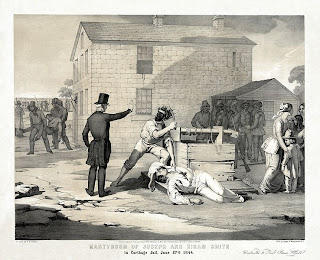
The murder of Joseph Smith(1844)

In the aftermath of its passing, Cherokee Indians were removed from their lands, with the Department of the Interior subsequently outlawing a list of “offensive” Native American rituals. 1844 saw a mass migration of Mormons to Utah; as a result of the violent lynching and murder of Mormon founder Joseph Smith in an Illinois prison. The Ku Klux Klan proceeded to taint American history by putting into place their malicious brand of intolerance, amassing over 4 million members in a crusade of anti-Semitism and anti-Catholicism. To make matters worse, the trying period of the Second World War was marred by a new dimension of religious hatred that Roman-Catholic priest Father Charles Coughlin put forward in American culture, with decidedly anti-Semitic radio addresses. Defending Nazism and Fascism, Coughlin blamed the Depression on an "international conspiracy of Jewish bankers” in a viral CBS radio broadcast. 

A Ku Klux Klan recruitment poster circa 1920

Reverend Charles Coughlin

Today, nearly a quarter of the American population still erroneously thinks Obama is Muslim, probably because of his numerous endeavors to improve America’s tainted image in the Islamic world. His outreach to the American-Muslim though has been much quieter, and so, when Muslims like Imam Rauf and his wife set out to build formal mosques, they are rendered exposed, and vulnerable.


Intolerance, though metamorphosing over periods of time, seems to continue to remain firmly woven in the fabric of American society. Perceptions of Islam have worsened significantly in the past two years. Until a distinction is made between religion and fanaticism, and an understanding reached, that American-Muslims represent a diaspora of every race and sect of Islam, Park51- even if it comes through by way of some miracle- will remain a soulless, empty gesture at most.

Monday, November 22, 2010

Germany: EU's Reluctant Pilot? by Malvika Tripathi


Europe faces testing times since the creation of European Union back in 1950s, amidst protests against austerity measures primarily in Southern Europe. As Germany’s Vice Chancellor Angela Merkel declared, “Europe is at crossroads again. If the Euro fails, Europe fails." Economists believe financial stability and more crises are inevitable, courtesy -irresponsible economic policies, a shrinking and rapidly aging population. The Greek crisis exemplifies this volatility since several other economies mainly Portugal, Spain and Ireland deal with the worst unemployment rates and poor banking. A bailout package did help out Greece and Germany (out of responsibility as Europe’s largest economy growing annualized rate close at 9 percent, as per eurostat, since reunification two decades ago) was the largest contributor at an unprecedented 22.2 billion Euros out of the 900 billion Euros aid scheme.

The Euro currency has had its fault in rigidity because of the central problem that EU didn't create the right institutional machinery when it created a unified currency. Once states give up their own currencies, they cannot deal with financial or fiscal crises by devaluation by debt ridden countries dreading years of deflation and stagnancy ahead. As Greece's credit worsened, Merkel nonetheless fueled the perception that she would rather kick indebted countries out of the currency zone than offer hard-earned German money to spendthrift southern Europeans.

For their part, the Germans have made it clear that they are tired of supporting their dubious partners. Even though, demand for exports would rise as euro weakens, France and Germany are torn between protectionism and idealism-whether to protect their own industries and workers or save Europe as a whole. Euroskeptics believe that the effort to salvage Greece was more for justifying Germany’s vision of a collective Union than its actual willingness.

At having to bail out the rest of the EU combined with frustration at being the single biggest contributor to the EU project while at the same time having the smallest amount of influence (in proportion to both economic might) stoked resentment from German taxpayers. Germany has invested more in the EU than any other member state, yet has had comparatively little say in how the project has evolved.

Germany most trusted to lead the European Union out of its turmoil even as economic nationalism has appealed more to the general public. The Greeks, on the other hand, have not gone down well with the help received, so much so comparing the crisis to the Nazi invasion of Greece. It is hard to see how the EU could make progress on market liberalization or deal with a financial crisis with a reluctant and inward-looking Germany leading way.