Tuesday, November 23, 2010

A Strategic Partner Above Moral Grounds by Simi Sunny

After two long decades of a repressive military regime, Myanmar took the road to democracy with the November 7th elections. The validity of the election results are already considered dubious with the junta-backed USDP declared the winners garnering 76.5% of the votes. Many were skeptical of the election process from the beginning itself because of the ban on many of the important parties like NLD (National league for Democracy) headed by Aung San Suu Kyi and parties representing ethnic minorities but still the formation of parliament after 22 years is being looked up by most of the world as a move towards reform. Even the release of Aung San Suu Kyi, who was under house arrest for more than fifteen years, on November 13th was welcomed by the world especially the West. This isolated nation has been an interesting facet of south East Asian politics. Myanmar has had one of the most repressive and abusive regimes in the world and constantly faced scrutiny for gross human right violations since years. Despite so it has got a varied response in the international policy from the world nations.

The U.S has been one of the biggest critiques of the policies of the nation since the military coup of 1962. It has till recently followed a policy of complete non engagement and imposed sanctions on the country time and again. It was under the pressure of U.S and United Kingdom that the Myanmar issue was first taken up in the Security Council of the United Nations for the first time in 1995. Myanmar’s nuclear programme with the support of Russia has also been one the contentious issues between the two nations. Concerns were also raised about high prevalence of drug trafficking in the country. Thus U.S and Europe has had a history of strained relation with Myanmar and always urged a move towards Democracy and release of the political prisoners.

But the failure in this regard has been the full commercial engagement of two of the biggest nations in Asia- China and India. China has been an ally of the junta regime since 1988 due to its strategic significance. Myanmar not only provided China the much needed trading outlet to the Indian Ocean but also was large resource of oil and natural gas. It was of vital military importance safeguarding the trade routes and could also act as a check on India’s growing influence in the region. Around 1993 India in its effort to counter the growing alliance between the two countries revaluated its pro-democracy stance to enter into several bilateral trade agreements and state visits by heads of the state. Since then India has built major roads, highways, ports and pipelines in the region to increase its influence in Indo-China peninsula.

There have been many critics of the policies of both China and India for ignoring its moral responsibility for its trade profits, the most recent one being President Obama who condemned India for remaining silent in face of violent suppression of the democratic movements in Myanmar. China has come under immense pressure from both the ASEAN and the UN to encourage a democratic government in the country. But both the countries have continued to ignore them. Myanmar has been ravaged by mass killings and brutal economic policies of the junta recording the worst GDP rate. Sanctions have failed to make an impact and India and China’s crude economic and political cooperation makes it even more difficult for the people of Myanmar to see the light of a peaceful regime.

Saare Jahaan Se Achcha by Ramya Patnaik

A Manipur Protest

What is it about men who see fit to poke a barrel into young chests without apparent emotion, and with this single act, alienating them from the democratic process, inflicting anguish and injustice? More importantly, what keeps those who claim to understand the situation fully well from diluting the quagmire with real solutions and not blinkered laws?  An India that never falters to raise allegations of cross-border terrorism and undemocratic functioning at a neighbouring country becomes the proverbial ostrich, ducking its head into voluntary ignorance, hoping its own grave domestic problem will just go away.

The Armed Forces (Special Powers) Act has become a dirty word in media speak. No longer is its futility shrouded by the official line on perceived perpetual security threats in the North East and Jammu and Kashmir. Yet, the process of ironing out the security concerns in order to do away with the Act and put into place a semblance of normal life has few takers in the government or public discourse. The issue has largely been relegated to some episodes of archival or documentary material on the evening news or boxed items on an obscure page of the ‘National’ section. Thus, it isn’t rocket science to guess that an average Joe wouldn’t be able to make sense of the bulk of antecedents to the issue.

The story of AFSPA takes on a double trajectory in two regions of the country synonymous with civil conflict and governance anomalies. Introduced in September 1958 to the “disturbed areas” of Arunachal Pradesh, Assam, Manipur, Meghalaya, Mizoram, Nagaland and Tripura, it was later extended to Jammu and Kashmir in July 1990. In its alacrity to quell insurgent voices, the Indian government has blurred its ability to discern between what can be termed as a ‘national threat’ and what simply an exercise of basic free speech is. One does not seek to dissect the ideological stand of various separatist groups in both parts of the country with as much gusto as making an appeal in the name of those caught in the crossfire. Granted, the crushing squalor of a few thousand mothers or the existentialist angst of young blood may seem paltry pitted against the billions worth of trade and infrastructure development; but as children, we are taught the vitality of dealing with problems head on, instead of sitting on them to exacerbate them irreparably.

Irom Sharmila
The watermark of Gandhi is the most circulated image in the country. But are his values hollow and uninteresting to a nation that never knew him beyond school exams? Was textbook Satyagraha never the pivot of our freedom movement? Irom Sharmila Chanu was 28 when she realized what never hits many of us in an entire lifetime- that resolution to act doesn’t have a doctrine or an ideology discrete from righteousness. Her unparalleled 10 year-long fast would put Mr. Gandhi to shame but it doesn’t seem to move Delhi at all. It all boils down to this one simple fact- how would one feel if ones colony or city or state was under constant surveillance? Wouldn’t it pinch to be stopped and checked at every turning? Wouldn’t the occurrence of all this on an everyday basis frustrate one to the point of madness? Why is it then, so difficult for those in power to realise that the prolonged imposition of this Act or at least certain sections of it breeds further unrest? The unbridled rage and anguish of the 30 women who protested in front of the Assam Rifles Headquarters with banners of “Indian Army rape us too” after Manorama Devi’s raped and tortured body was found in a ditch is nowhere near being appeased. If security concerns are to be met, those in power need to separate it from civil life in a permanent and non-interfering manner. The people have cried themselves hoarse for long enough. If another security ‘concern’ takes shape in the near future, the answer to whose fault it is wouldn’t be difficult to answer.

The Naxalite Movement In India by Angira Chaudhury

[Reuters/UNI photo]

The recent violent killings of hundreds of people including large number of security forces by Naxal troops in Chhattisgarh, Jharkhand and Maharashtra etc. have drawn the attention of the Indian media which has highlighted these events as acts of ‘terrorism’. However, a section of intellectuals and human right workers, most notably, Arundhati Roy has differed from such opinion. In my opinion, terrorism may have individual following but it has no mass base. Naxalism is quite different from terrorism as it has ideological mass base in many areas of the country. The genesis of ‘Naxalism’ is very interesting. It is a product of long ranging ideological differences within the Indian communist movement.

The Communist International (Comintern) was set up by Lenin in 1919, just after the October Revolution of 1917. The main aim of Comintern was determined to expand communist ideology and help establish communist parties wherever they did not exist. In this way Comintern also talked of International revolution. Lenin, aware of possible violent ideological thinking in the International communist movement wrote the famous book titled ‘Left Wing Communism: An Infantile Disorder’, cautioning communist leaders who believed in armed revolution.

However, there were always two currents in the Indian Communist Movement. The success of China’s communist revolution in 1949 after the Second World War had a deep impact on Indian Communist leaders. A section of the Movement started believing that an Indian revolution would be successful through armed struggle, as seen in China. Due to ideological differences of left and right, The Communist Party of India split in 1964 leading to the formation of the Communist Party of India (Marxist) or CPI (M).

When left front formed the coalition government in West Bengal in 1967, the ideological differences became very sharp within CPI (M). Incidentally, around the same time a tribal youth named Bimal was attacked by his landlord and his hoodlums as he tried to till his land after getting a judicial order for the same in Naxalbari, West Bengal. The local leaders of CPI (M) like Charu Majumdar, Kanu Sanyal and Khokan Majumdar etc., took out a procession in protest of the landlord’s actions on 25th May 1967. The gathering of mostly tribal people was attacked by the police, initially killing 7 woman and two children. The event marked the beginning of the Naxalite movement.

The aforementioned local leaders of Siligudi came out with slogans of capturing state power through armed struggle. For this purpose, Charu Majumdar and Kanu Sanyal pledged to follow techniques of Guerilla warfare. Such was the popularity of the slogans that the Chinese media highlighted them too. This is how the ideology of armed struggle found a new base in West Bengal.

The movement spread towards Debra- Gopiballabhpur area of Midnapore district of Bengal and Mushari area of Bihar. Considering growing ideological base Charu Majumdar with the help of other local leaders of CPI (M) formed an organization known as All India Coordination Committee of Communist Revolutionaries.

Soon this movement found its base in the Telangana region of Andhra Pradesh. As a result Charu Majumdar and his followers decided to form a political party to lead armed revolution in India. In 1969, the anniversary of Lenin’s birthday, a new party was formed named Communist Party of India Marxist/ Leninist in Kolkata. After the formation of CPI (ML) Charu Majumdar provided a slogan to boycott elections in 1969.  He also called for a cultural revolution calling students to boycott the capitalist education system and burning libraries and laboratories; also dismantling the statues of national leaders like Mahatma Gandhi, Jawaharlal Nehru and Subhash Chandra Bose etc.

In the matters of foreign policy Naxalite leaders emulated Chinese foreign policy in declaring the Soviet Union as a social imperialist nation. They also came out with a slogan ‘China’s chairman is our chairman’. Charu Majumdar also provided a slogan of individual annihilation of the class enemy. Individual killings would later become a rampant feature of the Naxalite Movement.

It is interesting to note that the movement has seen numerous splits throughout its history. In spite of all these weaknesses Naxalite groups have succeeded in spreading their mass base in different tribal areas of the country like Chhattisgarh, Jharkhand, Telangana and Orissa. At present, most of their activities are concentrated on killing central police and other security personnel. They have also adopted a policy of holding people for ransom. In this way their leadership has been converted into different groups of bandits.

Ashim Chatterjee, one of the leading figures of the bloody Naxalite revolt of the late 1960s, spoke to prokeralanews.com in April 2010 criticizing the present lot of Maoists, for only relying on arms and operating from the jungles by ignoring people and the doctrine of class struggle.

"Firstly, the conditions which set the stage for a revolutionary movement are absent in India. Secondly, these Maoists have not cared to build up class struggle. And when you fight against the state without caring to build up class struggle, it amounts to social terrorism. The blood that is being shed is meaningless," he said.

Their original ideologies have been lost in the wilderness; this is why voices from many corners are being raised to treat Naxalism as on par with terrorism. However, there is another opinion that the Naxalites have spread their mass base in areas where particularly tribal people suffer from lack of land reform, education and employment. Therefore, in dealing with the issue, the various individual causes and contextual details of the Naxalite revolution must be taken into consideration. 

BJP’s Pendulum Policy: Moderate Government; Extremist Opposition by Angira Chaudhury


The Bharatiya Janata Party (BJP) draws elements of its political philosophy from the erstwhile Bharatiya Jana Sangh. RSS (Rashtriya Swayam Sevak Sangh), a cultural organization with common roots, has undeniably acquired a reputation for indulging communalism in mainstream Indian politics, for the realization of their ultimate ideology- cultural nationalism. The position of the BJP on such behavior has never really been critical. In practice, the party hasn’t held back from doing the same and has been criticized on occasions for its communal vote-bank politics.

Initially, the BJP was a party that followed a broader ideological path than the Jana Sangh. It is unique to note that in the 1984 Lok Sabha elections BJP could win only 2 seats in the Parliament with its ideology of Gandhian socialism. However, the Shah Bano Case of 1985 and the Faizabad district court order regarding the unlocking of Babri Masjid premises of 1986 marked a shift in ideology for the BJP. The issue of ‘Ram Janmabhoomi’ was raised on a mass scale. L.K.Advani, the leader of BJP, launched many so-called ‘Rath Yatras’ from Somnath and travelled throughout north India, communalizing the atmosphere on religious line. As a result, ‘kar sevaks’ identified as members of RSS and BJP along with its satellite organizations like Vishwa Hindu Parishad (VHP) and Bajrang Dal demolished the Babri Masjid on 6th December 1992 leading to widespread communal disharmony across parts of the country.

The demolition of the Babri Mosque polarized people on religious line. India had never seen such a division among the people after independence since Partition. BJP began to instigate people in the name of Hindutva to get political support in the elections. As a result, in due course of time BJP captured power in many states of north India like U.P., Gujarat, Madhya Pradesh, Maharashtra etc. Its growing strength forced many regional parties to join its front which brought BJP to power at the centre in 1998.

When Atal Behari Vajpayee became Prime Minister of India, BJP adopted a dual policy. Since a combination of about two dozen parties had brought BJP in power, it became a moderate party leaving all controversial issues aside like building of Ram Temple in Ayodhya and abolition of Article 370 which provided special status to Jammu and Kashmir etc. However, in which ever state BJP had captured power on its own it began to follow a hard-line Hindutva policy based on intimidating minorities like Muslims and Christians. Its most dangerous example can be found in Gujarat where Narendra Modi became a symbol of hard-line Hindutva after the 2002 Godhra Riots. It was typical of BJP to project Vajpayee as a true secularist and liberal politician with the political capability of integrating ideologically heterogeneous political forces while encouraging Narendra Modi as a lion of Hindutva forces at the same time. Thus Modi became the true ideologue of RSS.

RSS and BJP claim that they believe in cultural nationalism. In this context it is interesting to note that analyzing post Godhra riots situation in Gujarat, Ashok Singhal the International President of the VHP openly spoke to the effect that people who described it as a riot were mistaken, and the actions of the kar sevaks were spontaneous expressions of cultural nationalism in the true sense.

When BJP lost power at the centre in the Lok Sabha elections 2004 its real dual character emerged. BJP disrupted parliament sessions on many a minor occasion. It tried to combine religious issue with political demand. Another example is the party’s agitation over the Amarnath Yatra in Jammu and Kashmir. It also launched violent protests over the Rameswaram Shipping Project in Tamil Nadu, based on the mythical belief that Lord Rama had built a bridge over the sea, linking India to Sri Lanka on the same spot. The focus of these protests was the matter of people’s ‘astha’ (faith), which cannot be destroyed. In the name of ‘astha’ BJP has tried to foil the basic concept of Indian constitution on numerous occasions.

 It will be interesting to watch BJP in the coming days, leading up to the Ayodhya verdict by the Lucknow bench of the Allahabad High Court. RSS/ VHP supporting outfits have already started recruiting cadres for the so-called ‘Ram Sena’ in parts of the country. All these activities indicate that whatever may be its response, the BJP is definitely expected to be in the eye of the storm.

Structure of Success by Tarini Bakshi

The now iconic Hands installation 

During the British era, Indian competency and inventiveness was in a deplorable state as it was looked upon with suspicion and was highly despised. After they relinquished their command, India was left to tumble in the slough of despond characterised by lack of dynamism and self esteem. However today we claim India to be ‘dynamic’ and ‘self confident’. But if we look closely we see India veering blindly without any constraint towards total globalisation and westernisation.

In today s era of open economic borders, there is a sense of ‘dependency’ that we seem to possess. The Indian mentality somehow remains convinced and complacent about the fact that we are incapable of producing anything of real value without foreign dilution. The swanky new terminal 3 at the Indira Gandhi International Airport cited as the 8th largest in the world, comes loaded with enthralling characteristics. However behind its entire mind –boggling details lies an important fact that Terminal 3 is not wholly an Indian brainchild. The terminal 3 though built in Delhi was designed by American architects and managed by MGF, a Dubai based consortium. It uses tempered glass, a steel frame and aluminium cladding-all shipped from abroad. The Terminal 3 is definitely world class as it is built and conceived by literally the whole world.

The whole country is in awe of the various spectacular venues of the Commonwealth games. However they reveal a similar story. The enrapturing indoor stadium for badminton and squash has been designed by a renowned Australian architecture firm-Peddlethorp. The designs for Thyagraj stadium, the rugby sevens venue at Delhi University and the Yamuna sports complex are conceptualised by Peddlethorp as well. The JNU stadium has been given a facelift by a German engineering firm –Schlaich Bergermann and Partners. India proudly boasts of metro connectivity in its capital city, however, each coach of the metro has been imported from South Korea.

All new projects that aim to adorn Indian image and set new international standards are a manifestation of the aforementioned point of dependency. The Commonwealth games stadiums, the metro, Terminal 3- do depict India’s best architectural foot and are stunning examples of contemporary architectural vocabulary, however they remain diluted as they are results of foreign implants. The only question that remains unanswered is –where is the home-grown talent, Indian wisdom and pride?

The Second Judiciary?? by Simi Sunny


Last summer when the Aarushi Talwar twin murders took place, the whole nation was glued to the news channels. As the drama unfolded, the media and the police transcended even the possible scope of imagination to guess the culprit and introduced their own conspiracy theories. They reported everything from the family’s life style, Aarushi’s habits, to her relationship with her friends. The channels went berserk with the coverage of the case. TRPs sky-rocketed, for it provided all the masala of a saas-bahu soap. The most interesting part was the conspiracy theories of each channel. The state of the marriages of Talwars and Durranis became ‘breaking news’. The media did not even spare the victim and spun stories of a relationship between Aarushi and the servant, Hemraj. The case became disturbing example of to what extent a sensation hungry media can go to cater to the people’s thirst for voyeurism and curiosity. The recent Ruchika Girhotra molestation case was another example of media’s growing obsession with revealing the truth. SP Rathore’s images flashed across channels portraying him as the dangerous devil.

The media has for years gloated over its role in the Jessica Lall and the Priyadarshini Mattoo case. Media activism was indeed the reason for the justice being delivered in these cases. It was the support of the media which turned the tide especially when the suspects belonged to influential families like the son of a former cabinet member and a police officer respectively. The media exposed the lapses in the prosecution and influenced the public to rise up against the court’s decision.

The trial by media has begun a tug of war between two conflicting principles –free press and the free trial. The phenomenon has created a gulf between the two leading public institutions-the media and the judiciary. According to the 17th Law Commission there are certain restrictions placed on the Freedom of Press granted by Article 19(1)a. It states that material which has a prejudicial impact on the suspects, accused, witnesses and even judges and in general the administration of justice should not be allowed to be published. Such a report can tend to influence or pressurize the judge in delivering prejudiced judgment. It also tends to hurt the position of both the defense and the prosecution.

Implications of a media trial were most obvious in the Noida twin murder case. As Dr.Talwar walked out of the Dasna Jail media realized it had indeed gone overboard with allegations and ended up apologizing for character assassination and defamation. Media which hails judicial activism seeks exemption when it comes to them. It takes up the role of the prosecutor and passes the verdict with such a propaganda-like zeal that the confused nation which listens to every twist and turn accepts it as the ultimate truth. We don’t even try to question the position taken by the media just to be part of the righteous public. Television coverage today raises doubts about the right of an accused to dodge the stigma of conviction even before the trial. It serves what interests the public and not what is public interest.

The media has a responsibility towards the society and it needs to ensure that punishment is delivered to the culprits and the innocents acquitted. But in the rush for business profits and high TRPs, it has failed to rein in its frenzied and irresponsible reporting. It’s time the media accept accountability in its reporting and abide by the ethics of journalism.

The Social Network by Akanksha Narain


Gone are the good old days of letters and pen pals, thanks to the numerous social networking sites cropping up. Status updates, photo comments, wall posts and tags- that’s how the Gen Y does it. The internet has created a new rage of networking and connecting with the world around us.

Every passing day seems to back Marshall McLuhan’s claim that the media would make the world a ‘Global Village’, sites like Facebook being primary examples. Children as young as 5 years old are well versed with the activities that social networking entail- from liking posts to uploading photographs.

Social networking inevitably has returned to the spotlight as an issue of contention with the recent release of “The Social Network” – a film that explores the life and success of shrewd and prodigious Facebook creator Mark Zuckerberg, played by Jesse Eisenberg. The question inevitably raised in a discussion of this sort is that with the advent of sites like Facebook are we venturing into deep waters? On such sites we unknowingly drop our guard, putting up rather personal information and photographs for the world to see. We put up photographs of ourselves holidaying in Goa while burglars happily see this and rob our houses. How difficult is it to plan a robbery when we ourselves inform the world when it is that we will be returning home?

With the explosion of the phenomenon of the internet, parents began to express extreme worries about their children accessing questionable chat sites and giving out information to strangers who might take advantage of it. We all have heard of numerous cases of kidnappings and children running away with strangers they met on such sites. Social networking sites have definitely aggravated this situation. The recent rape case in Delhi, where the victim met the culprit on Facebook is a fine example.

On such sites we not only expose too much information that could be misused by unsocial elements but also information that could cost us our jobs and marriages. Thanks to Facebook bosses now know that whether you were really unwell or were actually partying with your friends, all thanks to your status updates! Moreover, thanks to social networking sites all your claims of being a teetotaller are quashed. Before marrying anyone parents and the to-be groom/bride go through your profile and pictures to know what sort of a person you really are.

So the next time you go on Facebook set up your security setting and make sure that you do not put information that could be misused by people.

Empowerment of Women- Is It A Mere Slogan? by Akanksha Narain


Pick up any Newspaper, switch on any Television Channel and what do we find? Incidents of Female foeticide, bride burning, dowry deaths and even Sati still being practiced. We need to hang our heads in shame as women who constitute nearly half the population in our country are not treated as equal. Though the Indian Constitution confers equal rights and opportunities for all, irrespective of gender, in reality it is not so. To provide dignity to its women folk, a mere legislature is not required. What is required is to educate women and thus empower them.

Our vision of India emerging as a Global Superpower can only be realized when its women who constitute nearly 50 % of its population are involved in issues of growth and development. Equality and respect to women is deep rooted in our ancient culture. In Indian mythology whereas the male Trinity - Vishnu, Brahma and Shiva are credited with the genesis of ancient civilization, the female energy- Durga is worshipped as the destroyer of evil, Laxmi as the goddess of wealth and Saraswati as the giver of knowledge and all creative forms.This should not be so in the cosmic frame, but also within each of us. As women, each one of us needs to recognize our own intense creative energy. Somewhere over the centuries, the status and glory attributed to women has become hazy.

So wake up! We ought to treat women at par with men. Only then can we say with pride that India is a democracy. Then only will our vision to be a superpower be fulfilled.

Should Religion Govern Us? by Akanksha Narain

The Times of India on July 16 had a very interesting story about a gay penguin couple, Harry and Pepper. The story described how the two had broken up after a five-year long relationship! The two loving creatures would take abandoned penguin chicks under their care. While surfing through blogs, I found numerous posts sympathizing with the penguin couple. It left me wondering why we can sympathize with gay penguins but mock homosexual humans?

 Despite homosexuality being prevalent amongst penguins they do not show any anti- social behaviour. Though penguins do not follow any religion, they are social and caring like human beings. In contrast, in the Hindu religion, snakes have a revered position and
are worshipped but they eat their young ones. Clearly, anti social. Hence the premise that everything related to religion is good does not always hold.

Then why is it that we allow religion to dictate us? Why is it that we silently nod our heads when religious leaders protest against recognition of Gay Rights? Even in the 21st century our laws are over shadowed by religion. Sanctity of human behaviour by religion does not hold good anymore. So, how can we allow the government and law to function on the dictates of religion? The government initially refused to recognise homosexuality stating that it is against the laws of nature and religion prohibits unnatural sex. With the scrapping of Section 377, consensual sex between adults of the same sex has been legally recognised despite initial hiccups.

 Though religion should act as a binding force, it is ironic to see how religion is diving mankind today.  Think about it and you will realize that religion is indeed dividing us. It is dictating us what to do and what not to do (not on the basis of right or wrong, but just on their interpretation of what is written in holy books).

We do not just have faith in religion; we have blind faith. When mixed with politics and law, religion usually results in catastrophe. I am not writing to vocalize my feelings for gay rights (which I do support) but to vocalize my feelings about how religion is being used to abuse us. I am not against religion, but strongly feel that religion and law cannot and should not be mixed. The result is always disastrous. 

Despite Uncertainty, Blogs Positively Gain Momentum by Malvika Tripathi


In about 20 years, Internet has grown from its infancy stage of surfing for information to a highly complex interdependent grid comprising of social media interacting with advertising and marketing models, along with superfluous information emanating from independent sites, bloggers or news websites. In essence, Internet has emerged multifaceted and the sheer multiplicity in content is what characterizes it today. The demographics comprise of Facebook and Twitter (social websites) and blogs which aggregates into one central feature-spontaneity. Earlier considered a means of data, it is now a platform for testing new technologies, business models and as experimental grounds for advertisers.

Web Logs, or blogs, are the most successful and contemporary form of expression on the web in recent times. Coming from a grey area in journalism, every blog has a theme and unique point. Bloggers do not always write with a time frame in mind they’re entirely on the discretion of the blogger whether it is serious like Huffington Post or an excuse to vent like a personal diary. A blog is intangible property with respect to its writer. They are fully responsible if anything controversial is put up. Plus its effect is instantaneous and high on interactivity with sometimes torrential comments within minutes. “Freedom of press is guaranteed only to those who own one”. Although, this would not hold true for conventional media giants but blogging sites have redefined press in a broader sense. It acts as an autonomous network for collective conversation in the modern day public sphere. But now multinationals, newspapers, magazines and even celebrities keep blogs either as a public relations necessity or gaining an upper hand in the blogosphere.

Numbers may argue that the blogging scene has diminished in its present status, the advent of networking sites have ousted blogging more into ‘irrelevance’ than ever before.  So given that the world hasn’t figured what exactly blogs are, let us assume that they are provisional (since mostly they require great deal of maintenance and instant analysis) and offbeat in style of expression. Blogs have still maintained an upward course, in gathering netizens at about 175,000 – 225,000 every day. Blogging is quite young as about 120 million blogs exist. Interestingly, a whopping 50 percent of internet traffic visits these 120 million blogs. The potential of this dynamic medium is often grossly miscalculated if not ignored. It can possibly hold be the most effective advertising online. As blogs cater to niche viewers, understanding consumption pattern and target groups is viable intercepting the portion of readers. 47 percent of online consumers now read blogs for advice. The blog networks that have survived the economic downturn in advertising and the explosion of competing content on the web credit coverage of narrow topics, along with business models that reach beyond advertising. Meanwhile (according to NY times), advertising revenue for magazines dropped 21 percent, and the number of ad pages sold dropped 28 percent. Blogs have also started to get recognised by Media Firms such as Washington Post (for the last 6 years) and recently Associated Press as a credible news source. Mainstream media has rebroadcasted and reported on factual information from blogs especially in time of conflict like during the Iran election protests or Myanmar military repression.

Another unprecedented phenomenon is complete liberty to bloggers over the advertisements that get placed, like in Google ads. Especially, where ownership is concerned, they are responsible for what goes up on their site and how well it will resonate with the readers. In terms of traditional media, it is path breaking because advertisers cannot directly influence content this way round. Such advertising models are light years ahead of print media. Newspapers have realised the prospective of blogs and blog advertising and are making the most of it.

Blogs are foreseen as a substantial part of the web. Innovators searching for inspiration for the next big thing will find it understanding how software programming and optimization of content can do.

Putting A Comic Spin on Things- An Interview with Sudhir Tailang by Deepa Rajan

Sudhir Tailang


A picture may be worth a thousand words but this would be a major understatement as far as the political cartoon is concerned. Through its many layers of art, symbols and metaphors, political cartoons offer sharp commentary and critique on the issues of the day. Political cartoonists, while aiming for the funny bone, entertain their readers with a raw representation of the truth, mocking the absurdities of political leaders, laws and social norms.
 Accomplished cartoonists such as Sudhir Tailang have a way of viewing normal, mundane incidents in a completely different light. Tailang’s book ‘No, Prime Minister’ is a compilation of 150 cartoons on Dr Manmohan Singh, which takes you down the last five years of Indian politics like a synoptic history lesson that for a change is completely arresting as opposed to boring. Tailang, who has been a cartoonist for close to 30 years first made a mark with his daily "Here and Now" cartoons in the Hindustan Times in the 1980s. He began his career with the Illustrated Weekly of India and now draws a daily caricature for the edit page of the Asian Age - under the "Here and Now" label.


1.       Being a cartoonist is a tremendously offbeat career path, especially in our country where medicine and engineering are given such importance. What was your inspiration in the early days?
Like any other child, I was very interested in drawing and comics. I believe that every child is born to do something. If everybody else is born to be a doctor, an engineer or nowadays an MBA student, then I feel one in a million is also born to be a cartoonist. I was one of them. Continuously in my student life, my cartoons were published in newspapers and magazines of repute, which while being a good source of pocket money, boosted my confidence as well. No one particular person was as such my inspiration- I would rather say that Phantom, Mandrake and Flash Gordon made me aspire to be a cartoonist.

2.       In order to present your thoughts on political matters through the means of your cartoon strips, are you required to follow the news aggressively to identify the issues of relevance?
Yes, absolutely. A political cartoonist, unlike a reporter or a correspondent, doesn’t have a beat. A cartoonist has to comment on issues as diverse as a man landing on the moon, Pakistan-India relations, American elections- basically covering areas like sports, entertainment, politics because anything of interest to the readers is of interest to a cartoonist. I watch television throughout the day and read about 10 newspapers daily in order to stay abreast of all that is happening in the world. It’s quite difficult and taxing, but I believe that if you enjoy something, then the hard work that goes into it is just a form of riyaaz.

3.       To what extent do the people that you lampoon appreciate your efforts and talent?
I find that most politicians like their cartoons. I remember this one incident- the HRD minister at the time was Dr Murli Manhoar Joshi, and his secretary called me one day and said “The minister is very angry with you; you must call him at once.” Later when I called Dr Joshi and asked him the reason he said to me “I am very upset with you- you haven’t made any cartoon on me for the last two months!” There are many others who call me up, and tell me that they like that morning’s cartoon on them- Advani, Madhavrao Scindia, Rajesh Pilot have all appreciated my efforts. Many of them even ask for copies to frame as keepsakes, like MS Gill and Mr Vajpayee. Mr Vajpayee in fact even invited me to meet him at his home when he was PM, and I made a feature on him based on my observations during that visit.

4.       What is the process involved in making your cartoons? Are you given a daily brief on the subject matter or is it your personal choice? Moreover, do you have to conform to the paper’s editorial stances?
I keep tabs on all the news throughout the day, and formulate and complete the strip by about 7pm. One cartoon takes about 10 hours every day. The subject and content is of my choice, as it is a one man’s view of the world, so nobody can tell me what to draw. I try not to conform to any editorial stance, and I have to fight very hard for that. Sometimes I have even lost jobs over this issue. The first 20 years of my career I had a completely free hand and nobody told me what to draw and what not to draw. It is the last 10 years where there have been pressures, both direct and indirect. Death of opinion is the news of the last few years. But no matter what, you just continue to fight.

5.       What are the essentials that must be kept in mind to excel at the art of making political cartoons?
A political cartoonist is essentially a political commentator- like an editorial writer; cartoonists have a point of view. And the real challenge is to present his/her commentary in a humorous way. Another important thing is that it is necessary that the cartoonist have a stand and a sound opinion. A cartoonist also needs to be good at drawing- he/she need not be a Leonardo Da Vinci but a cartoonist should have a particular style of his/her own that differentiates them. This can only be developed over years of practice. Most importantly a cartoon is 70 percent ideas and just 30 per cent art work. Drawing, thinking, and reading- they’re very important. It’s a combination of many talents.

6.       With a steady lack of youth in your field, do you feel that it might be a dying art- so much so that one day newspapers will cease to carry any cartoons?
I am sure that day will come very soon, but not because people don’t want to be cartoonists. Newspapers these past 15 years don’t want cartoonists. Scope for political cartoonists has decreased and opinionated political cartoons are now being replaced by graphic design. With the coming of TV, newspapers have been trivialized. Secondly there has been a complete commercialization of newspapers wherein newspapers have become a consumer product instead of a living creature. Newspapers in the last decade have been co-opted by the establishment. The prime focus is on making money and not to annoy anyone, and so they do not question any of the politicians- they prefer to eulogize and praise, particularly the more powerful politicians. From the surface it may look like democracy, but the freedom of expression today you see is a controlled freedom.

7.       Can you tell us any unusual incidents that have been particularly memorable over the course of your career?
As a cartoonist I have come across many interesting people. I’ve had death threats, and have even been forced to have body guards for a short while. Amongst many incidents, I remember one that was very touching. A Mr. Batra used to call me every day from Haryana, and tell me that that day’s cartoon was wonderful and so on. After a few years, I discovered that he was in fact blind, and his son used to read out my cartoon to him upon which he would then call me up.

8.       As a cartoonist, you pay a great deal of attention to detail, faces and mannerisms. Can you tell us some of the most identifiable features that you focus on while drawing different politicians?
In Manmohan Singh and Advani’s case i exaggerate their foreheads, making them much longer. I also focus on Mr Advani’s shy eyes, bushy eyebrows and toothbrush moustache. Mr Vajpayee’s most discerning features are his nose, the front lock of his hair and his toothless smile. They say, behind every man’s success there lies a woman, but I can say there are many women behind the success of a cartoonist like me such as  Mayawati, Jayalalithaa, Mamata Banerjee, Sonia Gandhi etc.  Ms Mayawati, I prefer to draw as a statue, with her hand bag as her biggest feature. Laloo Prasad Yadav is difficult to draw because you see, one cannot caricature a caricature. But my favourite politician to draw was PV Narasimha Rao, because of his pout, his nostrils and his stoic manner. 

Subterranean Saga by Deepa Rajan

The running narrative about 33 miners who were trapped in a copper mine in northern Chile since August 5 finally reached its crescendo 69 days later- with the world watching on October 13, 2010, all 33 miners were successfully rescued in what is being cited as the most dramatic and miraculous rescue operation ever. This belief probably holds true, what with the likes of US President Barack Obama and Pope Benedict the XVI sending out messages of respect and hope to the miners and the Chilean government.
Miner Franklin Lobo embraces his daughter Carolina after he was rescued on Oct. 13
The commentary from all sources is common: it's an unparalleled story of heroism and human will to survive. A large amount of resources and expertise was invested in keeping the miners in Chile comfortable (special clothing, custom-designed beds and lights, even vaccinations to avert risky diseases.) Not taking away from the steely determination of the Chilean miners, there have been many such previous human experiences where people have been trapped or deprived their bodies of sunlight much longer than these men. These very people and their stories offered the understanding of how the negative effects of an upset body clock in these miners could be prevented. Much information on humans' ability to survive in the darkness comes from the ‘underground science’ experiments of  French scientist Michel Siffre, who part of a NASA study, spent long periods in dark isolation to study the effect on his body.
More importantly, October marks the 68 year anniversary of the particularly inspiring tale of a group of Ukrainian Jews that fled to a cave to hide from invading Nazis seeking to make Ukraine ‘Judenfrei’- free of Jews. On the night of October 12 1942, as Jewish families were vanishing all over Nazi-occupied eastern Europe, the extended Stermer family found that while there was little refuge to be found anywhere on the Earth—but underneath the surface, lay sanctuary. The accidental cavers endured the horrors of World War II inside the massive underground sanctuary known as Priest's Grotto in Korolówka, Ukraine. They lived solely on wheat, leeks, and other food they could sneak through a nondescript entrance at the bottom of a sloping sinkhole for 344 straight days, before receiving a note from the surface that their town had been liberated.
Priest's Grotto

On the surface, Priest’s Grotto is little more than a hole in the ground amid the endless wheat fields undulating across western Ukraine, but at 77 miles, it currently ranks as the tenth longest cave in the world.  While the cave proved a superior refuge, with clean water sources, separate chambers for cooking and smoke ventilation, little or no flooding and a concealed and difficult entry, living in state of light deprivation for such an extended time takes an unprecedented effort. Researchers and geologists are issued standard gear of special boots to prevent ankle sprains, wicking underwear to avert hypothermia, a special suit, special gloves for gripping things and three independent light sources—and this is all for a day trip into a cave.  
The combination of stress and sensory deprivation the Jewish survivors endured was almost without parallel. Today, the Stermers’ experience continues to shape virtually everything about their lives. Pepkale Stermer, who was five years old on her descent into the cave, travels with small stashes of food to safeguard against the possibility of going hungry. The survivors remain devoutly religious, both in spite of and because of their time underground.
Very often, the first light seen by such famously trapped individuals is the shine of the media spotlight that fades quickly after their stories are told. The survivors in Chile are receiving the hero’s treatment, but according to the Associated Press in many countries like China, thirteen miners are killed on average every day. So in the midst of all the fanfare and red carpet treatment of ‘The 33’, the question that needs to be asked is that will this latest subterranean saga ensure that the Chilean miners are taken care of, and will it help increase safety in the future? 

The Man Who Left Behind A Legacy by Deepa Rajan

Stieg Larsson

At the risk of over simplification, Stieg Larsson is identifiably the Van Gogh of crime fiction. 

Just like the tempestuous painter, Larsson died an untimely death- much before he could bear witness to the phenomenal success of his trilogy. More importantly, in one of his letters, Van Gogh is known to have admitted that as he did not have any children, he viewed his paintings as his progeny. Larsson too, has no heirs to call his own, apart from the girl with the dragon tattoo, the one that kicked the hornet’s nest, and the one that played with fire.
Since they were posthumously published in 2005, Larsson’s Millennium Trilogy has catapulted Nordic Noir into the global literary space. Already hugely popular in Europe, so far, over 27 million copies of the Millennium novels have been printed, and the books have been made into three wildly successful Swedish films.

What really seems to make these books work is their setting. A completely Scandinavian crime thrillers crafted around journalist Mikael Blomkvist and his firebrand, tattooed, pierced, prodigious, bisexual computer hacker partner Lisbeth Salander- a duo that takes on corrupt businessmen, sex traffickers, violent bikers, junkies and crooked politicians. The main attraction of the books is the Sweden portrayed through the eyes of Larsson. There is meticulous attention to detail in Larsson’s work and as you read, every page paints a striking picture. The author, who clearly loved this place, and made it a point in his books to use real addresses and locations.  At the same time, the Sweden he gives us is real- freeing readers from the constraints of imagining it as a streamlined Ikea-esque paradise.  It has its share of demons too, very much like our own countries.


And then there are the characters. Blomkvist proves to be a complete antithesis to standard crime fiction detectives doomed to a perpetual state of brooding unhappiness. Identified as Larsson’s alter ego of sorts, Blomkvist is remarkably upbeat and socially well adjusted- exactly how Larsson is remembered by his friends.

Salander, is an infinitely more complicated conundrum- described as elfin, barely 90 pounds and as having dyed black hair “short as a fuse”, she possesses a sordid past to match her Goth appearance. Abused and wrongfully institutionalized as a child, Salander exhibits a world of scepticism about the potential of human goodness. Not really your average hero. What’s important though is that she represents the mistrust and cynicism that exist in the bowels of every human mind- doubting figures of authority, the people we love and even ourselves. Pippi Longstocking, the strong-willed character of Astrid Lindgren’s children’s books is cited as Larsson’s inspiration for Salander. Salander is a testament to all those who survive torturous childhood experiences and somehow grow into adults with notable skills and an intact distinction between right and wrong. But there are also perhaps elements of Larsson himself in her- they shared a diet consisting almost entirely of coffee, cigarettes and fast food- one of the reasons cited for Larsson’s heart attack- a fanatical disposition towards research and a resolute sense of justice and fairness.


Lisbeth itself is the namesake of a rape victim that Larsson in his childhood is said to have been unable to help. It is perhaps for this reason that through the Millennium trilogy there is a feminist undercurrent, and Larsson brings to prominent focus his abhorrence of violence against women. Despite numerous suggestions Larsson refused to change the rather grim Swedish title of the first volume, “Man Som Hatar Kvinnor,” or “Men Who Hate Women.”

Larsson died without leaving a will. This has resulted in an intense struggle between his partner Eva Gabrielsson and Larsson’s father and younger brother.  Although legally Gabrielsson has no claim, she possesses a crucial piece of the Larsson legacy: a laptop computer containing roughly three-quarters of a fourth novel. According to Gabrielsson, in 2005 the Larsson’s offered to give her Stieg’s half of their apartment in return for the laptop. She refused, calling the offer extortion, and they eventually relented, very likely under the weight of public opinion, and let her have the whole apartment for nothing. Last November, the Larsson’s told a journalist that they were willing to settle the dispute for 20 million kronor (roughly $2.6 million). Gabrielsson didn’t respond.


In 1995 Larsson co-founded Expo, an anti-racist Swedish publication on which Millennium is loosely based. Despite its humble beginning the magazine nevertheless succeeded in upsetting the people Larsson was writing, about exposing him to multiple death-threats as an “enemy of the white race.” Such right-wing extremism was a legacy from World War II, when some Swedes secretly supported the Nazis, particularly rampant in the 90s.  This convoluted history has invariably fuelled speculation regarding Larsson, embroiling him in a variety of conspiracy theories that persist on calling his death an assassination. Life doesn’t necessarily imitate art but in this case, Larsson himself has now become one the opinionated, upright Swedish characters in his own books- entwined in a tale of envy, vested interests and mysterious manuscripts.

A History of Prejudice by Deepa Rajan

Park51 is a rather innocuous name for an issue that is in fact creating a furore in the United States. The brainchild of Imam Feisal Rauf and his wife Daisy Khan, Park51 is the project which lays down plans to build a Muslim cultural centre and mosque, situated two blocks from Ground Zero in New York City. Although approved by city authorities, as well as Mayor Michael Bloomberg, it’s safe to say that these plans will probably never see the light of day with the continuous avalanche of uproar that it faces.  With the debate gaining momentum, it has become a test for a slew of issues, from public opinion, political posturing to religious tolerance.

While some opponents are genuinely concerned about the issue that an Islamic cultural centre near the hallowed Ground Zero might be offensive to the families of victims, there are many opponents whose arguments are fuelled by a worrisome Islamophobia. Since August, the site has seen demonstrators in hordes carrying signs like “All I Need to Know About Islam, I Learned on 9/11.”  The Park 51 protests is a result of brewing intolerance against Muslims in America since 9/11 that have crystallized and strengthened over the past few years. Where ordinary citizens are concerned, there is evidence that hostilities are growing.  “Islamophobia has become the accepted form of racism in America,” comments Muslim-American writer Arsalan Iftikhar. A TIME-Abt SRBI poll has shown findings which indicate that 46% Americans believe that Islam is more likely to encourage violence than other religions, with a simultaneous 61% opposing the Park51 project.

The arguments presented by the detractors of Islam are common. Islam must necessarily be a violent creed, since those who conducted the 9/11 attacks were Muslims. Passages from the Koran are taken out of context and recited as examples to prove that Islam is a savage, backward creed- a death cult to which constitutional freedoms don’t apply.

A further problematic observation is that intolerance, in the history of America, is in no way isolated to Islam. Mormons, Jews and other religious, cultural and ethnic groups are still victims of hate speech in a nation founded on ideals that profess religious freedom and tolerance. Not just isolated to prominent pastors from Gainesville, Florida  announcing intentions of burning Korans on the anniversary of the 9/11 attacks, this form of discrimination dates as far back as to the founding of colonies. In early colonial life, Quakers, Lutherans, Catholics and Jews were vigorously expelled from the Puritan colonies in New England. Peter Stuyvesant, the last Dutch Director-General of the colony of New Netherland (currently New York) is known for his refusal to allow Jews from Northern Brazil to settle permanently in New Amsterdam in 1654. 

Peter Stuyvesant


In a letter to the Dutch West India Company, Stuyvesant fervently argued that “the deceitful race—such hateful enemies and blasphemers of the name of Christ—be not 
allowed to further infect and trouble this new colony.” By the 1800s, forced expulsion was a fairly common practice in America, marked by the Indian Removal Act signed into law by President Andrew Jackson. 

Artistic rendering of the The Cherokee Trail of Tears(1836-1839)
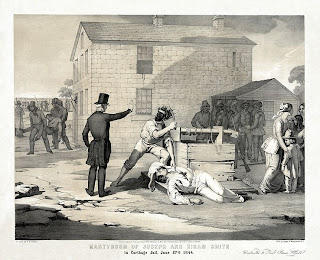
The murder of Joseph Smith(1844)

In the aftermath of its passing, Cherokee Indians were removed from their lands, with the Department of the Interior subsequently outlawing a list of “offensive” Native American rituals. 1844 saw a mass migration of Mormons to Utah; as a result of the violent lynching and murder of Mormon founder Joseph Smith in an Illinois prison. The Ku Klux Klan proceeded to taint American history by putting into place their malicious brand of intolerance, amassing over 4 million members in a crusade of anti-Semitism and anti-Catholicism. To make matters worse, the trying period of the Second World War was marred by a new dimension of religious hatred that Roman-Catholic priest Father Charles Coughlin put forward in American culture, with decidedly anti-Semitic radio addresses. Defending Nazism and Fascism, Coughlin blamed the Depression on an "international conspiracy of Jewish bankers” in a viral CBS radio broadcast. 

A Ku Klux Klan recruitment poster circa 1920

Reverend Charles Coughlin

Today, nearly a quarter of the American population still erroneously thinks Obama is Muslim, probably because of his numerous endeavors to improve America’s tainted image in the Islamic world. His outreach to the American-Muslim though has been much quieter, and so, when Muslims like Imam Rauf and his wife set out to build formal mosques, they are rendered exposed, and vulnerable.


Intolerance, though metamorphosing over periods of time, seems to continue to remain firmly woven in the fabric of American society. Perceptions of Islam have worsened significantly in the past two years. Until a distinction is made between religion and fanaticism, and an understanding reached, that American-Muslims represent a diaspora of every race and sect of Islam, Park51- even if it comes through by way of some miracle- will remain a soulless, empty gesture at most.